





-
Cardiometabolic diseases (CMDs) are a cluster of interconnected disorders involving metabolic disorders, such as type 2 diabetes mellitus, along with cardiovascular complications, including ischemic heart disease and heart failure[1]. These conditions are often interrelated and share common pathophysiological mechanisms such as insulin resistance, chronic inflammation, and oxidative stress. CMDs are now established as a leading cause of mortality worldwide, as underscored by the nearly 18 million cardiovascular-related deaths recorded in 2019[1,2]. In China, more than 40% of the deaths are attributed to cardiovascular diseases[3]. A central phenotype of CMDs is metabolic syndrome (MetS), characterized by abdominal obesity, hypertension, glucose intolerance, and dyslipidemia, which significantly contribute to cardiovascular morbidity[4,5]. The prevalence of MetS among adults in China ranges from 21.5% to 32.3% by different definitions, posing a substantial public health challenge[6,7].
Chronic urticaria (CU) is an immune-mediated skin disorder characterized by recurrent wheals and pruritus that last for more than six weeks[8,9]. CU affects approximately 1% of the global population and has a strong effect on health-related quality of life[10]. A previous study based on the China Chronic Disease and Risk Factor Surveillance (CCDRFS) dataset reported a weighted CU prevalence of 2.6% (95% confidence interval [CI]: 2.4%–2.8%) in the general adult Chinese population[11]. Studies examining temporal trends indicated that the prevalence of CU has increased over time[12].
Emerging evidence suggests a link between CMDs and CU[13,14]. A hospital-based study in Korea reported that 29.8% of patients with CU had MetS compared with 17.8% of those without CU[15]. Data from the CCDRFS project indicated that patients with cardiovascular diseases had a 1.6-fold risk of CU relative to the general population; higher CU prevalence was also significantly detected in patients with diabetes or dyslipidemia[11]. This association may be attributed to the shared underlying pro-inflammatory states between CU and CMDs, including enhanced oxidative stress, altered adipokine profiles, and activation of coagulation pathways. Inflammatory markers such as C-reactive protein, interleukin-6, tumor necrosis factor-alpha, and eosinophil cationic protein are elevated in patients with CU and those with MetS, reflecting systemic inflammation and a prothrombotic state[11,15].
However, despite the growing interest in the relationship between CMDs and CU, the epidemiology of CU within the CMD population has not been well characterized. Understanding the burden and risk factors for CU in this high-risk population can inform integrated management strategies. This study investigated the epidemiology of CU in Chinese adults with CMDs. Additionally, we sought to identify independent risk factors for the development of CU in this population and evaluate whether the coexistence of CU influences the recognition and management of CMDs. These findings may help clarify the effect of CU on CMD management, optimize integrated care for patients with CMDs, and provide new insights into interdisciplinary interventions for chronic inflammatory conditions.
-
The sixth CCDRFS was a nationwide cross-sectional survey conducted between August 2018 and June 2019, covering all 31 provincial administrative regions in mainland China. The survey adopted a multistage stratified cluster random sampling method to recruit a representative sample of the national population. Details of the survey design and methods have been published elsewhere[16-18] and are provided in Supplementary Methods. The survey included 184,876 participants who fulfilled the following criteria, with a response rate of 94.9%: 1) age ≥ 18 years; 2) residence at the survey site for more than 6 months in the past 12 months; 3) not pregnant; and 4) no serious health conditions that would impede participation or communication. All the participants signed an informed consent form before data collection. This survey was approved by the Ethics Review Committee of the National Center for Chronic and Noncommunicable Disease Control and Prevention of the Chinese Center for Disease Control and Prevention.
Two analytical cohorts were defined: (1) the CMD cohort (n = 118,036), comprising all participants diagnosed with at least one CMD with complete urticaria-related information, was used to estimate CU prevalence and identify related risk factors, and (2) the full cohort (n = 173,453), comprising all participants with complete urticaria-related information irrespective of CMD status, was used to assess the effect of CU on CMD awareness, treatment, and control. Supplementary Figure S1 shows the participant flow diagram illustrating the selection process. In both cohorts, participants with CU were considered the case group, and those without CU served as the control group.
-
Data were collected through face-to-face interviews, using a comprehensive questionnaire containing information on sociodemographic characteristics, lifestyle factors, and self-reported and investigator-diagnosed medical histories. Physical and laboratory examinations were performed during interviews. Physical examinations included height, weight, and blood pressure; laboratory examinations included fasting plasma glucose, oral glucose tolerance test, hemoglobin A1c (HbA1c), total cholesterol, high-density lipoprotein cholesterol, low-density lipoprotein cholesterol, triglycerides, and serum uric acid.
CMDs were defined as the presence of any of the following six chronic conditions: hypertension, diabetes, dyslipidemia, hyperuricemia, coronary artery disease, and stroke. The exact definitions of each CMD are listed in Supplementary Table S1. Three disease management indicators were assessed: awareness, treatment, and control. Awareness was defined as the proportion of patients who reported prior diagnosis of a condition by a physician. Treatment was defined as the proportion of patients who had taken prescribed medication for that condition in the past two weeks (for hypertension), or reported taking prescribed medication, managing diet, or having increased physical activity (for diabetes and dyslipidemia) at the time of the survey. Control was defined as the proportion of treated participants who achieved the target levels (blood pressure < 140/90 mmHg for hypertension, HbA1c < 7.0% for diabetes, and lipid levels meeting the criteria defined in Supplementary Table S1 for dyslipidemia).
CU was defined as wheals, angioedema, or both lasting for > 6 weeks in the preceding 12 months[8,9]. Although specific International Classification of Diseases (ICD) codes were not collected, this definition aligns with the standard clinical criteria (ICD-10: L50.8) and international urticaria guidelines.
Age was categorized into 10-year intervals. Residence was divided into urban or rural areas according to the National Bureau of Statistics of China. Seven geographical regions were defined according to their natural and socioeconomic conditions at the provincial scale[19].
Smoking status was categorized as never smoked, former smoker (had habitually smoked in the past but stopped before the survey), or current smoker (actively smoking at the time of the survey). Excessive alcohol consumption was defined as alcohol consumption of ≥ 25 g/day for men and ≥ 15 g/day for women during the past 12 months. Sleep duration was collected by asking, “On average, how many hours of sleep do you get per day?” with response options in hours and minutes.
-
When describing the weighted characteristics of the CMD population, estimating the prevalence of CU within the population, and comparing CMD management strategies stratified by CU comorbidities, the complex survey design was accounted for by incorporating stratification, clustering, and sampling weights. Sampling weights were constructed to adjust for the prespecified sampling design, non-response, and discrepancies between the sample and the 2010 Chinese population census. The Taylor series linearization method with finite population correction was applied to estimate standard errors and 95% CIs.
The associations between potential risk factors, including sociodemographic characteristics and lifestyle factors, and CU development were examined using multivariable logistic regression analyses in which the complex survey design was accounted for by incorporating clustering (via cluster identifiers), stratification, and finite population correction. Key design-related variables (age and sex) were included as covariates to adjust for differential selection probabilities.
The following potential risk factors were included in the multivariable logistic regression model based on previous literature and clinical relevance: age, sex, residence (urban/rural), geographic region, education level, smoking status, excessive alcohol consumption, sleep duration, and body mass index[11,20].
All analyses were conducted using the R software (version 4.4.2). Statistical significance was defined as a two-sided P-value of < 0.05.
-
The sixth CCDRFS recruited 118,036 participants diagnosed with CMDs with available urticaria-related information (CMD cohort), representing a weighted population of 571,431,385 Chinese adults. In this cohort, 4,199 participants had CU (case group; weighted population: 16,557,782) and 113,837 did not (control group; weighted population: 554,873,603). The weighted characteristics of the study population are summarized in Table 1: 23.6% were aged 60 years or older, 40.1% were female, 48.3% resided in rural areas, and 68.5% had less than a high school education. Compared with participants with CMDs without CU, those with CU tended to be older; female; residing in rural areas and the north, northeast, northwest, and southwest regions; did not smoke or consume excessive alcohol; and had shorter sleep durations.
Overall
(% of weighted population)Participants without chronic urticaria
(% of weighted population)Participants with chronic urticaria
(% of weighted population)Sample (n) 118,036 113,837 4,199 Weighted population (N) 571,431,385 554,873,603 16,557,782 Age (years) 18–29 18.8 19.0 15.0 30–39 16.7 16.8 11.1 40–49 21.7 21.7 21.0 50–59 19.2 19.1 21.7 60–69 13.0 12.8 17.6 70+ 10.6 10.6 13.6 Sex Men 59.9 60.1 52.9 Women 40.1 39.9 47.1 Residence Urban 51.7 51.8 49.2 Rural 48.3 48.2 50.8 Region North 12.3 12.3 14.6 South 11.6 11.5 10.9 East 29.6 29.8 23.2 Central 15.5 15.5 14.7 Northeast 10.1 10.1 11.2 Northwest 6.7 6.7 8.9 Southwest 14.2 14.1 16.5 Education Less than high school 68.5 68.3 76.1 High school 17.4 17.5 14.1 College or above 14.1 14.2 9.8 BMI (kg/m2) <18.5 2.2 2.1 3.7 18.5-23.9 33.9 33.9 34.7 ≥24 63.9 64.0 61.6 Cigarette smoking Never 62.9 62.8 65.8 Former 6.5 6.4 7.4 Current 30.6 30.8 26.8 Excessive alcohol drinking No 89.4 89.4 90.5 Yes 10.6 10.6 9.5 Sleep duration (hours) <5 3.3 3.2 6.4 5-6.9 20.7 20.5 26.3 7-10 73.8 74.1 64.6 >10 2.2 2.2 2.7 Note. Cardiometabolic diseases were defined as the presence of one or more of the 6 chronic conditions including hypertension, diabetes, dyslipidemia, hyperuricemia, coronary artery disease and stroke. BMI, body mass index. Weighted Population Demographic Characteristics: sample (n) =118,036, weighted population (N) =571,431,385. Table 1. Weighted characteristics of Chinese adult participants with cardiometabolic diseases, 2018–2019
-
The overall weighted prevalence of CU among the patients with CMDs was 2.90% (Table 2). A significant overall increasing trend in CU prevalence was observed with advancing age, rising from 1.92% (95% CI: 1.53%–2.32%) in individuals aged 30–39 years to 3.94% (95% CI: 3.59%–4.29%) in those aged 60–69 years (P = 0.001). This age-related increase was more pronounced among females (P < 0.001) and rural residents (P < 0.001). Females exhibited a significantly higher prevalence of CU (3.41%, 95% CI: 3.09%–3.72%) than males (2.56%, 95% CI: 2.14%–2.98%; P = 0.001), with the difference being particularly marked in rural areas (females: 3.84% (95% CI: 3.38%–4.30%) vs. males: 2.46% (95% CI: 2.11%–2.80%), P < 0.001).
Characteristics Overall (%) Sex Residence Men (%) Women (%) Urban (%) Rural (%) Total 2.90 (2.59, 3.20) 2.56 (2.14, 2.98) 3.41 (3.09, 3.72) 2.76 (2.27, 3.24) 3.05 (2.71, 3.39) Age (years) 18–29 2.31 (1.23, 3.38) 2.79 (1.30, 4.27) 1.10 (0.56, 1.65) 2.88 (1.06, 4.71) 1.55 (0.89, 2.21) 30–39 1.92 (1.53, 2.32) 1.57 (1.15, 1.99) 2.72 (1.91, 3.54) 1.74 (1.21, 2.27) 2.18 (1.58, 2.77) 40–49 2.80 (2.43, 3.18) 2.50 (2.06, 2.94) 3.29 (2.77, 3.82) 2.33 (1.87, 2.79) 3.32 (2.75, 3.89) 50–59 3.28 (2.94, 3.61) 2.48 (2.17, 2.80) 4.15 (3.59, 4.70) 3.18 (2.64, 3.72) 3.37 (2.98, 3.75) 60–69 3.94 (3.59, 4.29) 3.29 (2.89, 3.69) 4.60 (4.13, 5.07) 3.69 (3.30, 4.09) 4.14 (3.63, 4.66) 70+ 3.71 (3.18, 4.24) 3.57 (3.00, 4.15) 3.82 (3.17, 4.48) 3.52 (2.96, 4.08) 3.86 (3.04, 4.67) P for trend 0.001** 0.025* < 0.001*** 0.057 < 0.001*** Sex Men 2.56 (2.14, 2.98) − − 2.64 (1.93, 3.36) 2.46 (2.11, 2.80) Women 3.41 (3.09, 3.72) − − 2.95 (2.59, 3.30) 3.84 (3.38, 4.30) P for difference 0.001 − − 0.442 < 0.001 Residence Urban 2.76 (2.27, 3.24) 2.64 (1.93, 3.36) 2.95 (2.59, 3.30) − − Rural 3.05 (2.71, 3.39) 2.46 (2.11, 2.80) 3.84 (3.38, 4.30) − − P for difference 0.338 0.640 0.001 − − Region North 3.42 (2.30, 4.55) 3.46 (1.59, 5.32) 3.38 (2.71, 4.04) 3.30 (1.25, 5.35) 3.57 (2.94, 4.20) South 2.74 (1.26, 4.23) 2.66 (0.58, 4.73) 2.90 (1.89, 3.91) 3.37 (1.09, 5.65) 1.76 (1.16, 2.37) East 2.28 (1.88, 2.67) 1.87 (1.50, 2.24) 2.91 (2.29, 3.53) 2.27 (1.86, 2.69) 2.28 (1.61, 2.96) Central 2.75 (1.96, 3.54) 2.22 (1.30, 3.13) 3.49 (2.59, 4.38) 2.79 (1.58, 4.01) 2.71 (1.94, 3.49) Northeast 3.20 (2.52, 3.88) 2.63 (1.81, 3.45) 4.01 (3.11, 4.91) 2.60 (1.89, 3.30) 4.08 (2.82, 5.34) Northwest 3.82 (2.76, 4.88) 3.55 (2.19, 4.92) 4.21 (3.32, 5.10) 3.32 (2.35, 4.29) 4.21 (2.75, 5.68) Southwest 3.37 (2.73, 4.01) 3.01 (2.29, 3.73) 3.88 (3.00, 4.76) 2.58 (1.66, 3.50) 3.92 (2.90, 4.94) P for difference 0.179 0.283 0.186 0.666 0.001** Cardiometabolic diseases Hypertension No 2.63 (2.17, 3.09) 2.36 (1.71, 3.01) 3.11 (2.79, 3.42) 2.63 (1.84, 3.42) 2.64 (2.30, 2.97) Yes 3.20 (2.91, 3.50) 2.81 (2.49, 3.14) 3.69 (3.28, 4.10) 2.92 (2.59, 3.25) 3.46 (3.02, 3.90) P for difference 0.031* 0.211 0.003** 0.501 < 0.001*** Diabetes No 2.77 (2.43, 3.10) 2.43 (1.97, 2.89) 3.30 (2.98, 3.62) 2.70 (2.14, 3.26) 2.84 (2.51, 3.16) Yes 3.39 (2.95, 3.82) 3.09 (2.47, 3.71) 3.73 (3.25, 4.21) 2.96 (2.42, 3.50) 3.91 (3.25, 4.56) P for difference 0.005** 0.051 0.040* 0.441 < 0.001*** Dyslipidemia No 2.95 (2.49, 3.41) 2.67 (1.97, 3.37) 3.34 (2.93, 3.75) 2.74 (1.91, 3.57) 3.15 (2.73, 3.56) Yes 2.87 (2.52, 3.22) 2.50 (2.02, 2.98) 3.44 (3.11, 3.78) 2.77 (2.22, 3.32) 2.99 (2.60, 3.37) P for difference 0.751 0.668 0.611 0.951 0.455 Hyperuricemia No 3.05 (2.74, 3.35) 2.67 (2.21, 3.13) 3.44 (3.12, 3.75) 2.86 (2.36, 3.35) 3.23 (2.86, 3.60) Yes 2.43 (1.77, 3.09) 2.34 (1.61, 3.08) 3.01 (2.26, 3.76) 2.50 (1.47, 3.54) 2.31 (1.83, 2.79) P for difference 0.099 0.443 0.280 0.546 0.001** Coronary artery disease No 2.77 (2.45, 3.08) 2.50 (2.06, 2.93) 3.18 (2.87, 3.50) 2.69 (2.19, 3.20) 2.85 (2.51, 3.19) Yes 6.11 (5.21, 7.01) 4.41 (3.11, 5.70) 7.83 (6.69, 8.97) 4.38 (3.21, 5.55) 8.02 (6.68, 9.37) P for difference < 0.001*** 0.001** < 0.001*** 0.004** < 0.001*** Stroke No 2.76 (2.45, 3.07) 2.47 (2.03, 2.90) 3.20 (2.89, 3.51) 2.63 (2.12, 3.14) 2.90 (2.57, 3.23) Yes 5.54 (4.73, 6.36) 4.42 (3.61, 5.23) 6.94 (5.81, 8.06) 5.47 (4.36, 6.57) 5.61 (4.37, 6.85) P for difference < 0.001*** < 0.001*** < 0.001*** < 0.001*** < 0.001*** Number of CMD conditions One chronic condition 2.65 (2.23, 3.08) 2.41 (1.74, 3.08) 2.96 (2.64, 3.28) 2.63 (1.84, 3.41) 2.68 (2.33, 3.02) Two chronic conditions 2.79 (2.45, 3.12) 2.37 (1.97, 2.76) 3.53 (3.06, 4.00) 2.58 (2.12, 3.03) 3.02 (2.57, 3.47) Three chronic conditions 3.77 (3.16, 4.37) 3.41 (2.61, 4.20) 4.45 (3.76, 5.13) 3.37 (2.57, 4.17) 4.25 (3.31, 5.18) Four chronic conditions 4.41 (3.61, 5.20) 2.93 (2.13, 3.72) 7.31 (5.57, 9.06) 3.82 (2.85, 4.78) 5.28 (3.87, 6.69) Five or six chronic conditions 6.29 (4.34, 8.25) 4.92 (2.56, 7.29) 8.62 (4.35, 12.89) 3.99 (2.29, 5.68) 11.27 (6.64, 15.90) P for trend < 0.001*** 0.004** < 0.001*** 0.031* < 0.001*** Note. Data are expressed as weighted prevalence (%, 95% confidence interval). P values were derived from Rao–Scott chi-square test or logistic regression applicable to complex survey. Cardiometabolic diseases (CMDs) were defined as the presence of one or more of the 6 chronic conditions including hypertension, diabetes, dyslipidemia, hyperuricemia, coronary artery disease and stroke. *P < 0.05; **P < 0.01; ***P < 0.001. Table 2. Weighted prevalence of chronic urticaria among participants with cardiometabolic disease, overall and by sex or residence
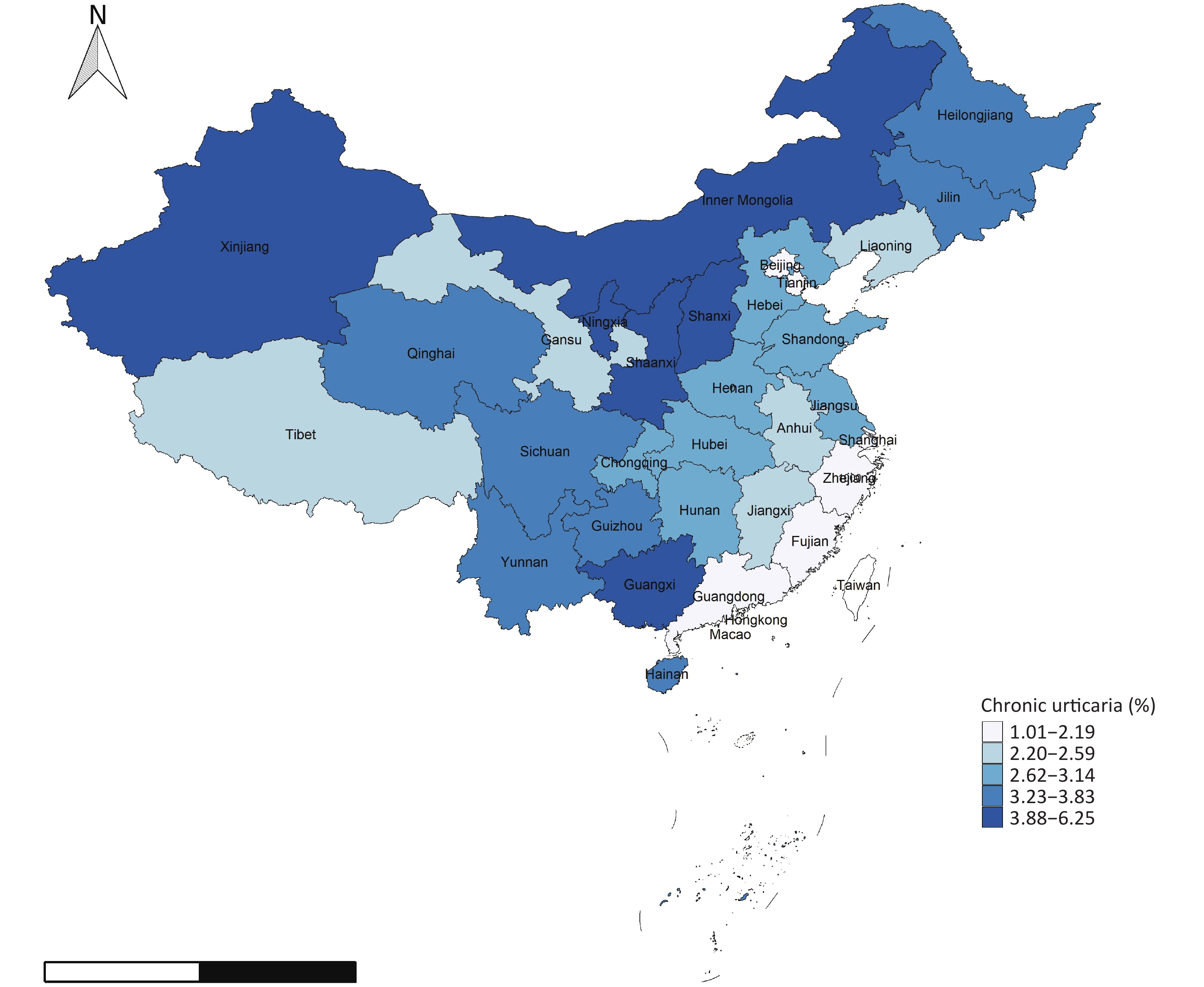
No significant difference in CU prevalence was observed between urban (2.76%, 95% CI: 2.27%–3.24%) and rural populations (3.05%, 95% CI: 2.71%–3.39%; P = 0.338). Although the overall variation across the seven geographical divisions was not statistically significant (P = 0.179), CU prevalence was higher in the northwestern, northern, and southwestern regions, particularly in Xinjiang, Ningxia, Shanxi, Shaanxi, Inner Mongolia, and Guangxi (Figure 1).
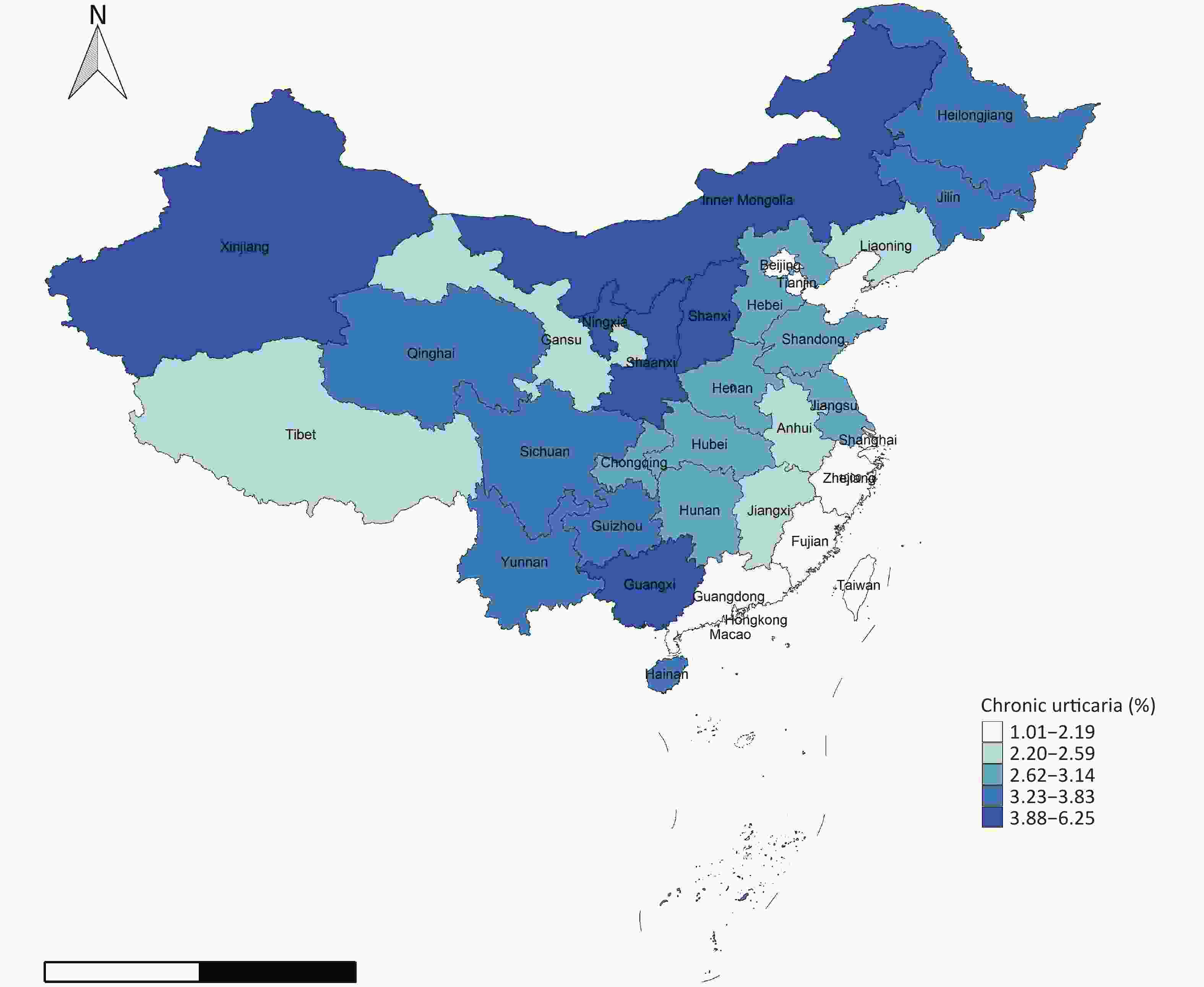
Figure 1. Weighted prevalence of chronic urticaria by province among Chinese adult participants with cardiometabolic diseases, 2018–2019. Awareness of chronic urticaria was defined as the proportion of participants who reported a previous diagnosis of chronic urticaria by a doctor among all participants with chronic urticaria. Cardiometabolic diseases were defined as the presence of one or more of the 6 chronic conditions: hypertension, diabetes, dyslipidemia, hyperuricemia, coronary artery disease, or stroke. Map approval number: GS(2024)_0650.
The weighted CU prevalence varied considerably when individual CMD conditions were examined. The highest CU prevalence was observed among participants with coronary artery disease (6.11%, 95% CI: 5.21%–7.01%) and stroke (5.54%, 95% CI: 4.73%–6.36%), followed by those with diabetes (3.39%, 95% CI: 2.95%–3.82%) and hypertension (3.20%, 95% CI: 2.91%–3.50%). In contrast, CU prevalence was lower among participants with dyslipidemia (2.87%, 95% CI: 2.52%–3.22%) and hyperuricemia (2.43%, 95% CI: 1.77%–3.09%).
Moreover, the prevalence of CU exhibited a significant increasing trend with greater cardiometabolic multimorbidity, rising from 2.65% (95% CI: 2.23%–3.08%) in those with one CMD condition to 6.29% (95% CI: 4.34%–8.25%) in those with five to six CMD conditions (P < 0.001). This trend remained consistent in the subgroup analyses according to sex (male, P = 0.004; female, P < 0.001) and residence (urban, P = 0.031; rural, P < 0.001).
-
Multivariable logistic regression analysis identified several factors significantly associated with an elevated risk of CU in participants with CMDs (Supplementary Table S2). These included advanced age (odds ratio [OR] 1.08, 95% CI: 1.05–1.11), female sex (OR 1.56, 95% CI: 1.43–1.71), rural residence (OR 1.18, 95% CI: 1.07–1.30), former smoking (OR 1.35, 95% CI: 1.20–1.53), current smoking (OR 1.17, 95% CI: 1.06–1.29), and abnormal sleep duration—encompassing both long (> 10 h, OR 1.39, 95% CI: 1.19–1.61) and short sleep patterns (< 7 h). A dose–response relationship was evident for sleep deprivation, with a markedly higher OR for CU among those sleeping fewer than 5 hours per night (OR 1.79, 95% CI: 1.61–1.99) than among those sleeping 5–6.9 hours (OR 1.26, 95% CI: 1.17–1.35). Conversely, residence in southern China was associated with a lower risk of CU (OR 0.81, 95% CI: 0.71–0.92).
-
In the full cohort, 5,789 participants had CU (case group) and 167,664 did not (control group). A higher weighted prevalence of CMDs was observed among participants with CU than among those without CU. The prevalence of hypertension (33.56% vs. 27.16%), diabetes (16.09% vs. 12.28%), dyslipidemia (42.10% vs. 38.13%), coronary artery disease (5.31% vs. 2.18%), and stroke (6.25% vs. 2.85%) was higher in the CU group than in those without CU (Table 3). The prevalence of hyperuricemia was similar between the two groups (13.13% vs. 14.11%) (Table 3). The prevalence, awareness, treatment, and control rates of various CMDs in the non-CU population were similar to those in the total population (Supplementary Table S3). Notably, the presence of CU was associated with improved awareness of CMDs. The weighted awareness rates for hypertension, diabetes, and dyslipidemia were significantly higher in participants with CU (50.71%, 47.14%, and 30.71%, respectively) than in those without CU (40.27%, 36.21%, and 17.12%, respectively) (Table 3). Higher awareness was associated with higher treatment rates. Among patients with CU, the treatment rates for hypertension, diabetes, and dyslipidemia were 41.37%, 41.31%, and 18.29%, respectively, compared with 34.22%, 32.52%, and 9.94%, respectively, in patients without CU.
CMDs % (95% CI) With chronic urticaria Without chronic urticaria Prevalence Awareness Treatment Control in treated patients Prevalence Awareness Treatment Control in treated patients Hypertension 33.56 (30.76, 36.36) 50.71 (47.25, 54.16) 41.37 (38.13, 44.61) 33.43 (28.71, 38.16) 27.16 (26.29, 28.03) 40.27 (38.91, 41.64) 34.22 (32.96, 35.47) 32.20 (30.64, 33.76) Diabetes 16.09 (14.32, 17.87) 47.14 (42.29, 51.99) 41.31 (36.08, 46.54) 50.10 (43.75, 56.45) 12.28 (11.72, 12.84) 36.21 (34.39, 38.04) 32.52 (30.71, 34.33) 50.19 (47.69, 52.68) Dyslipidemia 42.10 (38.91, 45.29) 30.71 (26.50, 34.92) 18.29 (15.19, 21.40) 34.43 (27.09, 41.78) 38.13 (37.13, 39.13) 17.12 (16.14, 18.10) 9.94 (9.28, 10.60) 38.46 (36.09, 40.82) Hyperuricemia† 13.13 (9.97, 16.28) − − − 14.11 (13.28, 14.95) − − − Coronary artery disease† 5.31 (4.38, 6.23) − − − 2.18 (2.01, 2.35) − − − Stroke† 6.25 (5.14, 7.36) − − − 2.85 (2.62, 3.09) − − − Note. †Awareness, treatment, and control of hyperuricemia, coronary artery disease, and stroke were not ascertained. CMDs, cardiometabolic diseases; CI, confidence interval. Table 3. Weighted prevalence, awareness, treatment, and control of cardiometabolic diseases among those with and without chronic urticaria, 2018–2019
However, the increased awareness and treatment rates were not associated with improved disease control. Among treated patients, the weighted control rates of CMDs were comparable between those with and without CU.
-
This nationwide cross-sectional study, which used data from the sixth round of the CCDRFS, provides a comprehensive epidemiological profile of CU among Chinese adults with CMDs. We identified a higher burden of CU among patients with more complex CMD conditions as well as key sociodemographic and lifestyle risk factors, and uncovered a notable paradox. Although CU comorbidity was associated with a higher burden of CMDs, it was associated with improved awareness and treatment initiation, despite the absence of a corresponding improvement in disease control. These findings address the core objectives of this study and have important implications for clinical practice.
A recent CCDRFS-based study of the general Chinese population reported a CU prevalence of approximately 2.6%[11]. The higher prevalence observed in our CMD population (2.90%) is consistent with the notion that CU and CMDs share common inflammatory pathways[21].
The identified risk profile for the development of CU revealed important demographic and geographic determinants. Our analysis confirmed that female sex and advanced age were associated with an increased risk of CU in patients with CMDs. This observation is consistent with the established epidemiology in the general population[11,20]. Sexual dimorphism may be partially explained by hormonal influences that regulate molecular mechanisms in both the innate and adaptive immune systems[22]. In genetically susceptible individuals, complex interactions between hormonal fluctuations and environmental factors may lead to immune response dysregulation, ultimately predisposing them to immune-mediated diseases, including autoimmune conditions such as CU[22]. The positive correlation between advanced age and CU risk can be understood through the conceptual framework of inflammation. In patients with CMDs, meta-inflammation, driven by excess nutrients and gut microbiota dysbiosis, converges with age-related inflammatory pathways, potentially lowering the threshold for mast cell activation and degranulation[23]. This synergistic interaction between meta-inflammation and inflammaging not only accelerates the aging process but also creates a permissive environment for CU development in older adults with CMDs.
Furthermore, multivariable logistic regression analysis revealed geographical and residential disparities in the CU risk among Chinese adults with CMDs. Residents of northern China showed an elevated risk of CU, which may be partly attributable to the regional climatic characteristics. Colder, drier winters, typical of the northern regions, can compromise skin barrier function[24], whereas reduced sunlight exposure inhibits the synthesis of vitamin D, a known modulator of immune homeostasis that can aid the clinical management of CU[25]. Concurrently, high levels of air pollution in some northern industrial areas may exacerbate inflammatory responses and contribute to CU development[26,27]. A parallel pattern was observed in rural populations, where limited access to healthcare resources likely contributes to the under-diagnosis and suboptimal management of both CMDs and CU[28,29], potentially creating a cycle of uncontrolled inflammation and sustained disease risk. Additionally, the higher prevalence of unhealthy lifestyle behaviors, such as smoking and alcohol consumption, in rural communities may further contribute to the increased CU burden in these areas[30].
Interestingly, stratified analyses revealed divergent patterns between the rural and urban populations. In rural areas, CU prevalence varied significantly across multiple demographic and clinical subgroups, including age, sex, geographic region, and number of CMDs, whereas in urban populations, significant differences were observed only across the CMD count subgroups. This disparity may reflect greater heterogeneity in socioeconomic status, healthcare access, environmental exposure, and lifestyle factors in rural areas[31], which may influence CU risk across different population segments. By contrast, urban populations may be more homogeneous in terms of healthcare access and environmental conditions, resulting in a more uniform risk profile. These findings highlight the importance of tailoring prevention strategies to the specific characteristics of rural and urban populations.
In addition to demographic and geographic factors, this study highlighted several modifiable lifestyle risk factors. Both current and former smoking statuses were associated with an increased risk of CU, suggesting that tobacco exposure may induce long-term alterations in immune function and inflammatory pathways. Nevertheless, promoting smoking cessation remains beneficial for the management of urticaria, as previous studies have shown that smoking frequency is associated with an elevated risk of urticaria and related hospitalization[32]. Furthermore, although most previous studies have suggested that sleep disturbances, particularly insomnia, are associated with CU[33,34], we identified a U-shaped relationship between sleep duration and the risk of CU. Both sleep deprivation (< 5 h/night) and prolonged sleep duration were independently associated with increased risk of CU, with particularly pronounced effects observed in patients with severe sleep deprivation. This pattern indicates that sleep dysregulation, rather than short sleep duration alone, may contribute to the pathogenesis of CU. Potential mechanisms include sleep-related alterations in hypothalamic–pituitary–adrenal axis function, increased pro-inflammatory cytokine production, and impaired immune regulation[35]. These findings suggest that adequate sleep duration and smoking cessation are potential modifiable factors in the management of patients with CU and CMDs. Further studies are required to determine whether interventions targeting sleep quality and duration can reduce the risk of CU or improve outcomes.
An important finding of this study was the association between CU and CMD management. The higher rates of awareness and treatment of hypertension, diabetes, and dyslipidemia observed in patients with CU suggest a potential link between visible skin conditions and increased healthcare encounters, which may create opportunities for CMD screening. We hypothesized that the bothersome nature of CU symptoms may lead patients to seek medical care more frequently, thereby creating opportunities for screening and initial diagnosis of concurrent, often asymptomatic, CMDs. This highlights an underutilized opportunity for integrated care within healthcare systems in which dermatology consultations could serve as a pivotal touchpoint for cardiometabolic screening. The observed disconnection between the improved treatment and unchanged control rates suggests a potential gap in the quality of chronic disease management, although causal inferences could not be drawn from this cross-sectional design. This finding indicates that the healthcare system is effective at identifying and initiating treatment but deficient in achieving long-term therapeutic goals. Potential barriers include therapeutic inertia (failure to intensify therapy when goals are not met), suboptimal medication adherence, inadequate patient education, and complex pharmacological management of CMD[36,37]. These results highlight the need for a shift from a focus on diagnosis and prescription to a sustained patient-centered approach that prioritizes treatment effectiveness and control.
-
The major strengths of this study include its large, nationally representative sample, use of standardized protocols for data collection, and application of complex survey analysis to ensure the generalizability of our findings. However, this study has certain limitations that must be acknowledged. First, its cross-sectional design precludes causal inferences. For example, the observed association between abnormal sleep duration and CU risk does not clarify the direction of causality: whether sleep disturbance contributes to CU pathogenesis or whether CU-induced pruritus impairs sleep quality. Similar uncertainties apply to the other identified associations. Longitudinal studies are needed to establish these temporal relationships. Second, the definitions of CU and some CMDs relied on self-reporting, which is subject to recall bias. Additionally, the definition of CU in our survey—wheals, angioedema, or both lasting for more than 6 weeks—did not specify attack frequency. This aligns with both international and Chinese guidelines for urticaria[8,9], which define CU based on duration alone, without requiring a minimum frequency of episodes. However, the lack of frequency criteria may have contributed to the variability in prevalence estimates across studies. Future studies that incorporate both duration and frequency criteria should enhance comparability. Third, the definition of CMDs in this study was based on chronic conditions that were explicitly defined and collected in the CCDRFS, including hypertension, diabetes, dyslipidemia, hyperuricemia, coronary artery disease, and stroke. We acknowledge that CMDs represent a broad spectrum of interconnected metabolic and cardiovascular disorders, and that it is neither feasible nor necessary to include every possible condition in a single study. For instance, obesity was excluded because of the lack of specific assessments such as abdominal obesity[5], duration[38], and subtypes[39]. Future studies with more comprehensive phenotyping are warranted to explore the association between CU and a wider range of CMD components. Fourth, sampling weights were not applied in risk factor analysis. Although this approach mitigates instability, it may not fully capture all the aspects of the complex sampling design. Because of the rarity of CU (weighted prevalence of approximately 3%), the application of sampling weights may have led to unstable estimates. Fifth, we lacked data on several potential confounders or effect modifiers, such as psychological stress and detailed medication history, which may influence CU risk.
-
This study found that CU is a prevalent comorbidity among Chinese adults with CMDs and is associated with a distinct set of risk factors encompassing demographic (advanced age and female sex), geographic (rural and northern residence), and lifestyle (smoking and abnormal sleep duration) domains. We additionally observed that CU is associated with a higher burden of CMDs and higher rates of CMD awareness and treatment. However, the observation that these higher rates were not accompanied by better disease control indicates a potential gap in the quality of chronic disease management, warranting further investigation. These results suggest that integrated interdisciplinary care models bridging dermatology and cardiometabolic medicine may be beneficial. Future prospective studies are required to determine whether using CU manifestations for systemic disease screening can improve long-term outcomes.
HTML
Study Design and Population
Data Collection and Definitions
Statistical Analysis
Study Population
Prevalence of CU among Participants with CMDs
Factors Associated with CU among Participants with CMDs
Associations of CU with the Prevalence, Awareness, Treatment, and Control of CMDs
Strengths and Limitations
Competing Interests The authors have no competing interests to declare.
Authors’ Contributions Conception and design of the study: Zhihui Yang, Tao Huang, and Limin Wang. Data acquisition: Xiao Zhang and Limin Wang. Data analysis: Xiao Zhang. Data interpretation: Zhihui Yang, Xiao Zhang, Wen Chen, Zuotao Zhao, Tao Huang, and Limin Wang. Manuscript drafting: Zhihui Yang, Wen Chen and Xiao Zhang. Manuscript revision: Zhihui Yang, Xiao Zhang, Wen Chen, Zuotao Zhao, Tao Huang, and Limin Wang. Funding acquisition: Zhihui Yang. Project supervision: Limin Wang. All the authors have approved the final manuscript. Zhihui Yang, Xiao Zhang, and Wen Chen are co-first authors who contributed equally to this study.
Data Sharin This study was conducted using data from the Sixth China Chronic Disease and Risk Factor Surveillance (CCDRFS) Project. The raw data are not publicly available. The supplementary materials will be available in www.besjournal.com.
&These authors contributed equally to this work.

 Quick Links
 DownLoad: