



-
Metabolic dysfunction-associated steatotic liver disease (MASLD), formerly known as non-alcoholic fatty liver disease (NAFLD), is characterized by hepatic steatosis and metabolic dysfunction, a condition that can progress to cirrhosis and hepatocellular carcinoma[1–3]. MASLD is the most prevalent chronic liver disease worldwide, affecting more than 25% of the Chinese population and placing a significant burden on national healthcare systems[4,5]. The pathogenesis of MASLD is multifactorial, involving not only established risk factors, such as obesity and insulin resistance, but also widespread environmental exposure[6,7]. Among these, endocrine-disrupting chemicals (EDCs) have garnered increasing attention because of their potential to disrupt metabolic processes[8,9].
EDCs are a class of exogenous compounds that can mimic or interfere with the actions of endogenous hormones. These include per- and polyfluoroalkyl substances (PFAS), organochlorine pesticides (OCP), polychlorinated biphenyls (PCB), polycyclic aromatic hydrocarbons (PAH), and phthalic acid esters (PAE)[10,11]. As the primary organ for metabolism and detoxification of these compounds, the liver is particularly susceptible to the detrimental effects of EDCs, which may contribute to the pathogenesis of MASLD[8]. However, evidence regarding the association between EDC exposure and MASLD in the Chinese population remains limited. Notably, individuals are typically exposed to multiple EDCs simultaneously, underscoring the importance of mixture exposure analysis for evaluating their health impacts. To date, most studies investigating the association between EDCs and MASLD have not considered the combined effects of exposure to multiple chemical classes[12,13]. Furthermore, given variations in hormone levels, metabolism, and susceptibility across sex and age groups[14], it is essential to further investigate the effects of EDC exposure on MASLD within specific demographic subgroups.
Serum ferritin (SF) is a widely used marker of body iron stores and contributes to systemic iron homeostasis by sequestering excess iron, thereby limiting iron-catalyzed oxidative injury[15]. Although SF levels can be influenced by inflammation, they remain a useful proxy for iron status despite inflammatory effects[16]. Disruption of iron homeostasis is a recognized hallmark of MASLD, in which hepatic iron overload promotes oxidative stress and inflammation, and aberrant iron distribution drives lipogenesis and fibrogenesis[17–19]. Furthermore, SF levels have been shown to influence the gut microbiota by facilitating fatty acid biosynthesis and glutathione metabolism, thereby promoting the development of MASLD[20]. EDCs have been associated with disrupted iron homeostasis[21,22]. Accordingly, we evaluated whether SF mediates the association between EDC exposure and MASLD risk, addressing a plausible iron-related pathway that remains poorly characterized.
We conducted a cross-sectional study using nationally representative data from the China Health and Nutrition Survey (CHNS). We aimed to identify key EDCs in the association between EDC mixtures and MASLD, evaluate their joint effects, and quantify the mediating effects of iron metabolism biomarkers on the relationship between key EDCs and MASLD. Furthermore, we sought to explore potential variations in these associations across sex and age groups.
-
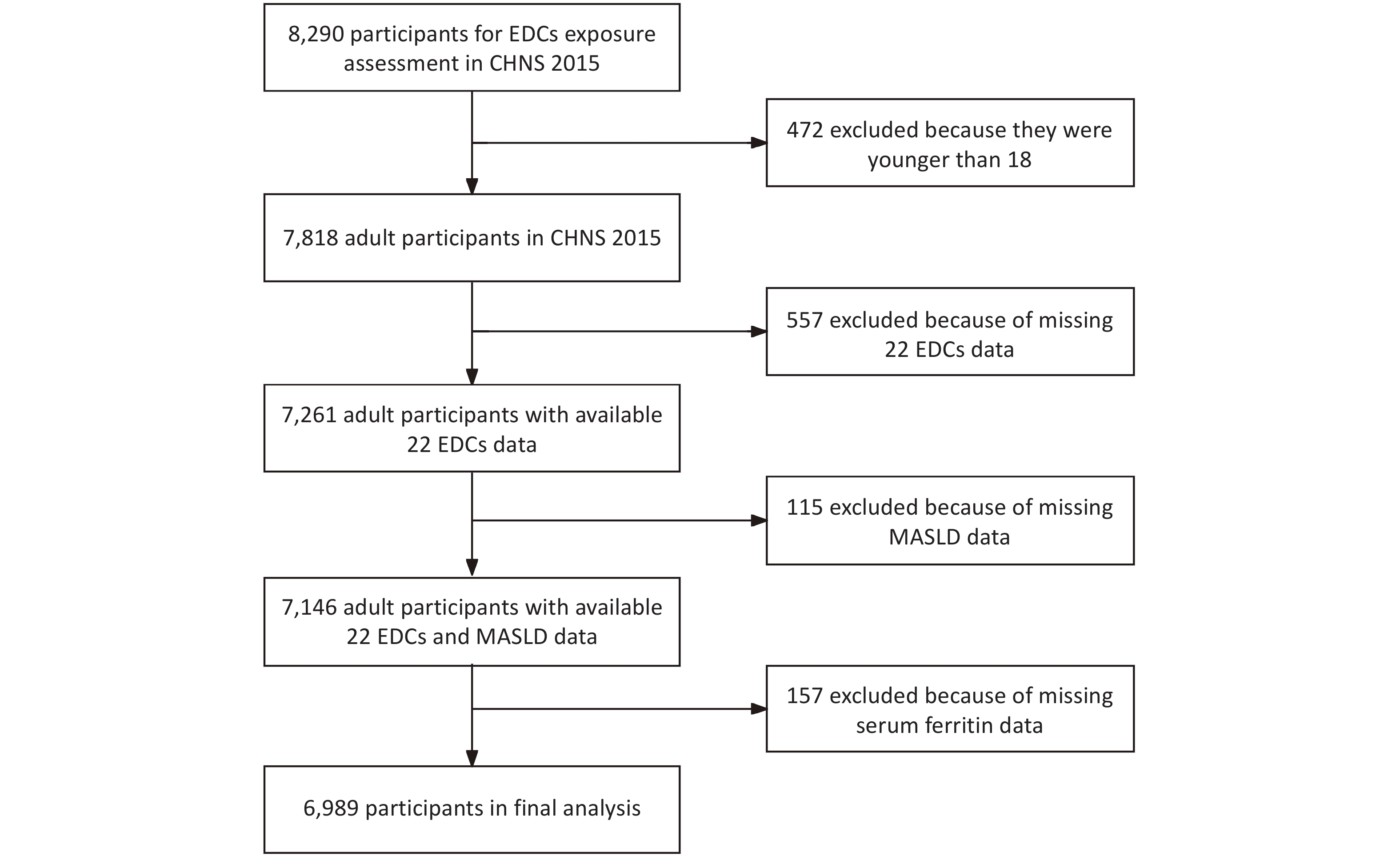
The CHNS is an ongoing prospective cohort study initiated in 1989, with follow-up every 2–4 years. It employs a multistage, random cluster sampling design to collect longitudinal data at the individual, household, and community levels from a representative sample of provinces across China[23,24]. Based on the availability of data on serum EDC concentrations, the 2015 CHNS cycle (n = 8,290) was included in this analysis (limited access data). We excluded individuals younger than 18 years, those lacking serum measurements of the 22 EDCs or SF levels, and those without sufficient information to evaluate MASLD status. The final analytic sample comprised 6,989 adult participants (Figure 1). All participants provided written informed consent before participating in the CHNS program.
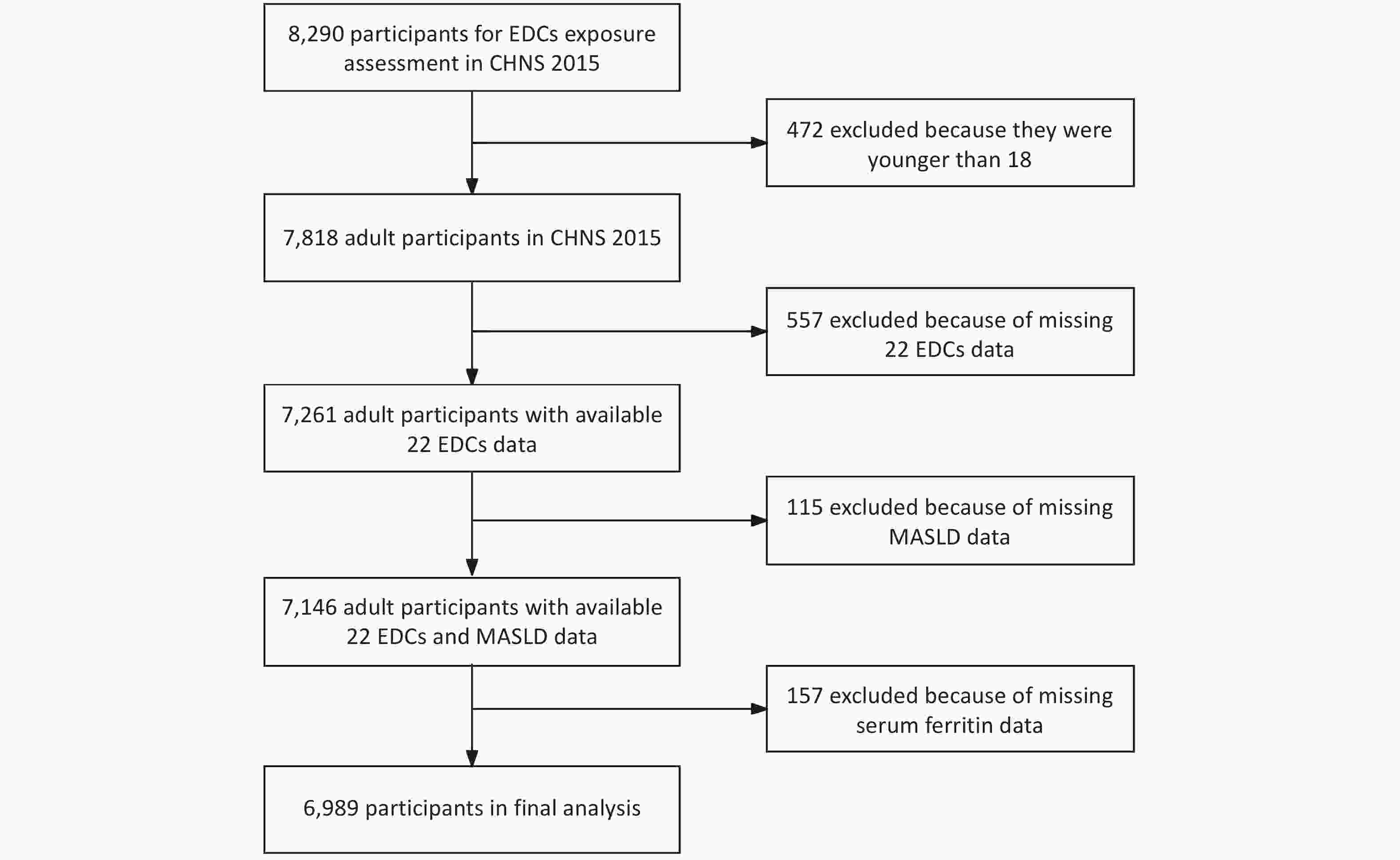
Figure 1. Workflow of participants included in the analyses. Abbreviations: EDCs, endocrine disrupting chemicals; MASLD, metabolic dysfunction-associated steatotic liver disease.
-
After the participants fasted for 8–12 hours, 12 mL of fasting blood was collected, divided into three 4 mL test tubes, and stored at −86 °C until analysis. Detailed methods for serum sample measurement and quality control have been described in previous studies[24]. Serum concentrations of PFAS, phenylpyrazole insecticides, and phthalate pesticides were measured using liquid chromatography-tandem mass spectrometry (LC-MS/MS), whereas concentrations of OCP, PAH, pyrethroid pesticides, and carbamate pesticides were measured using gas chromatography-tandem mass spectrometry (GC-MS/MS). Isotope-labelled internal standards were added to each sample for quantification and quality control. The limits of quantification (LOQs) ranged from 0.02 to 100 ng/mL for various analytes, the calibration curves showed good linearity (r2 > 0.99), and the accuracy (recovery rates of 80%–120%) and precision (relative standard deviations < 30% in quality control samples) were within acceptable limits. Rigorous quality assurance was implemented, including the analysis of procedural blanks, insertion of spiked quality control (QC) samples in each batch, and batch-specific calibration. All samples were analyzed within validated freeze-thaw cycles and stable storage periods. Detailed instrumental parameters, specific LOQs, and full QA/QC protocols have been described previously[24].
EDCs with detection rates below 50% were excluded, and concentrations below the lower limit of quantitation (LLOQ) were imputed as LLOQ divided by the square root of 2. A total of 22 EDCs were included, comprising: nine PFASs (perfluorooctanoic acid [PFOA], perfluorodecanoic acid [PFDA], perfluorononanoic acid [PFNA], perfluoroundecanoic acid [PFUnDA], perfluorohexanesulfonate [PFHxS], perfluoro-n-pentanoic acid [PFPeA], perfluorooctanesulfonate [PFOS], perfluorododecanoic acid [PFDoDA], perfluorotridecanoic acid [PFTrDA]); four OCPs (p,p’-DDE, p,p’-DDT, β-hexachlorocyclohexane [β-HCH], hexachlorocyclohexane [HCH]); five PAHs (acenaphthene [ACE], pyrene [PYR], phenanthrene [PHE], fluoranthene [FLT], chrysene [CHR]); one pyrethroid pesticide (etofenprox [EPX]); one carbamate pesticide (isoprocarb [IPC]); one phenylpyrazole insecticide (fipronil sulphone [SUL]); and one phthalate pesticide (monoethyl phthalate [MEP]). The LLOQ, detection rates, and distributions of the serum concentrations for the 22 EDCs are presented in Supplementary Table S1.
-
Trained examiners measured the body weight, height, and waist circumference of all participants using calibrated equipment following standardized procedures. The body mass index (BMI) was calculated by dividing the body weight (kg) by height squared (m2). After the participants rested for at least 5 minutes, sitting blood pressure was measured three times using a mercury sphygmomanometer. The mean values of the three measurements of systolic and diastolic blood pressures were used for the analysis.
Serum triglyceride (TG), high-density lipoprotein cholesterol (HDL-C), alanine aminotransferase (ALT), and aspartate aminotransferase (AST) levels were measured using enzymatic methods standardized by the International Federation of Clinical Chemistry. Fasting blood glucose (FBG) levels were measured using the GOD method. Glycated hemoglobin A1c (HbA1c) levels were assessed using high-performance liquid chromatography (Tosoh Corporation, Tokyo, Japan)[25,26]. SF levels were measured by radioimmunoassay using a gamma counter (XH-6020; Northern Institute of Biotechnology, Beijing, China)[27]. All samples underwent rigorous quality control at the National Center Laboratory in Beijing.
-
MASLD was defined based on the presence of hepatic steatosis, as determined by hepatic steatosis index (HSI), in conjunction with any of the following cardiometabolic risk factors: (1) BMI ≥ 23.0 kg/m2 in Asians or waist circumference ≥ 94 cm for males and ≥ 80 cm for females; (2) FBG ≥ 5.6 mmol/L or HbA1c ≥ 5.7% or treatment for type 2 diabetes mellitus (T2DM); (3) Blood pressure ≥ 130/85 mmHg or use of antihypertensive medication; (4) TG ≥ 1.70 mmol/L; (5) HDL-C ≤ 1.0 mmol/L for males and ≤ 1.3 mmol/L for females[1]. To assess the severity of hepatic steatosis and define MASLD noninvasively, the HSI is commonly used in Asian populations[28]. Hepatic steatosis was defined as an HSI > 36, calculated as follows: HSI = 8 × (ALT, IU/L) / (AST, IU/L) + (BMI, kg/m2) + 2 (if female) + 2 (if T2DM)[29].
-
Covariate data were collected via self-administered questionnaires and included sociodemographic information (age, sex, residence, education, annual household income), dietary intake (total energy, total fat, total cholesterol intake), and lifestyle habits (smoking, alcohol consumption, physical activity). These variables were self-reported during each survey cycle. Physical activity was quantified as metabolic equivalent (MET) hours per week, reflecting the level of oxygen required to maintain resting metabolism. For analysis, covariates were categorized as follows. Educational levels were categorized into three groups: junior high school or below, secondary school or high school, and college or above. Annual household income was divided into four categories: low income (less than 30,000 yuan), middle income (30,000–75,000 yuan), high income (75,000–120,000 yuan), and very high income (> 120,000 yuan). Smoking status was categorized as nonsmoker or smoker, and drinking status was categorized as nondrinker or current drinker (defined as alcohol consumption in the past year). Missing covariate data were handled using multiple imputation.
-
Continuous variables were presented as means with standard deviations (SDs) or medians with interquartile ranges (IQRs), whereas categorical variables were presented as frequencies and percentages (%). The t-test, Wilcoxon rank-sum test, and chi-square test were used to compare the characteristics between MASLD and non-MASLD participants. Spearman correlation analysis was used to calculate pairwise correlation coefficients for exposure to the 22 EDCs (Supplementary Figure S1). Due to skewed distributions, serum concentrations of EDCs, SF levels, and several covariates (physical activity, total energy intake, total fat intake, and total cholesterol intake) were ln-transformed (Ln) before analysis.
-
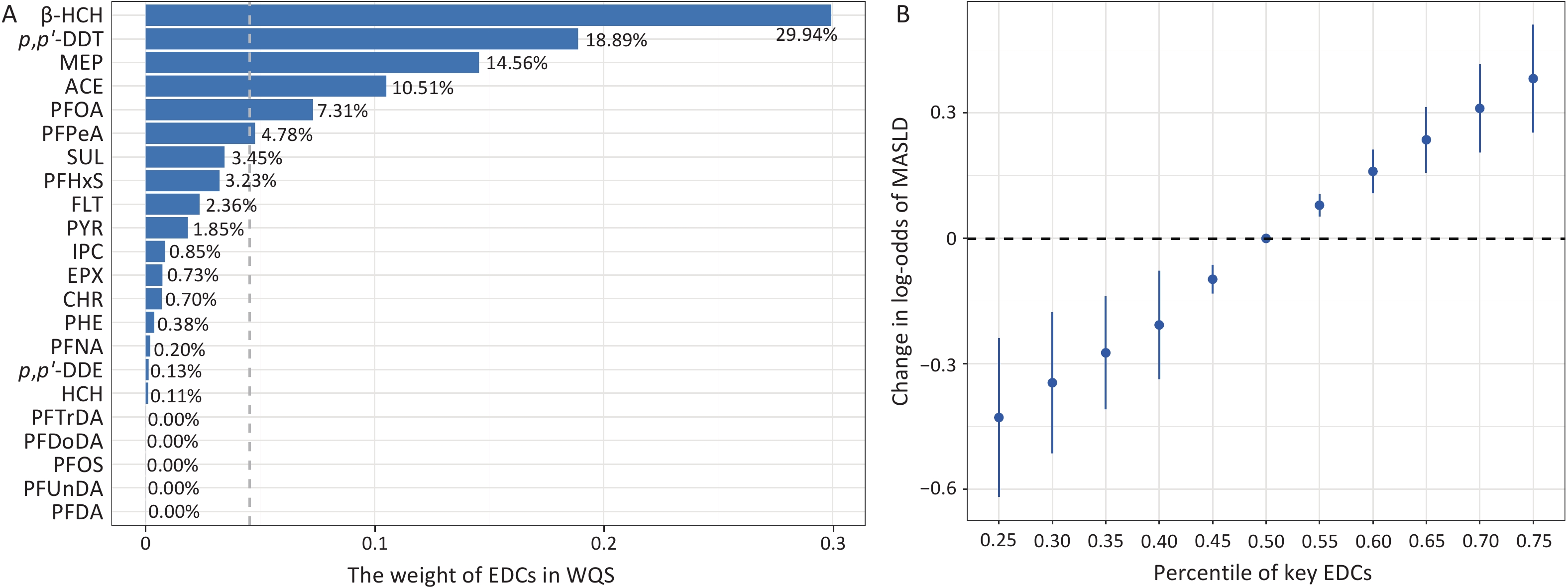
Logistic regression models were used to assess the association between individual EDC exposures (using continuous Ln concentrations grouped into tertiles, with the lowest tertile serving as the reference) and MASLD risk. Associations with a false discovery rate (FDR) q-value < 0.05 were considered statistically significant. Linear trend tests were performed by modelling the value of each tertile as a continuous variable. Weighted quantile sum (WQS) regression models were used to screen for key EDCs in the association between EDC mixtures and MASLD risk. The model was run using 10,000 bootstrap samples to obtain stable estimates. The weight assigned to each chemical, as reflected in the bar plot (Figure 2A), represented the average weight across bootstrap iterations, indicating its relative contribution to the combined mixture effect[30,31]. The reference threshold was set to 0.045 (1/n, where n = 22 represents the total number of EDCs in the mixture). EDCs with weights greater than or equal to the threshold value were defined as key EDCs and retained for subsequent analysis.
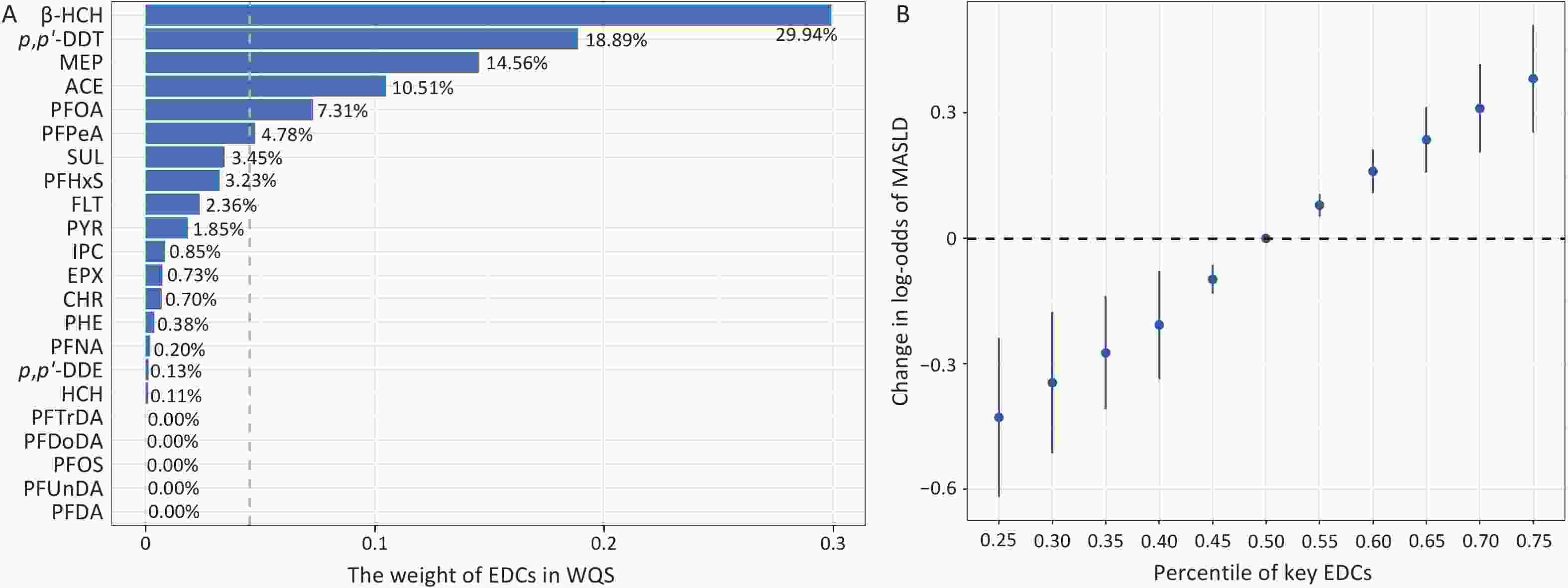
Figure 2. Results of the mixed-exposure analysis of the association of EDCs with MASLD. (A) Weighted Quantile Sum (WQS) regression results. The bar plot shows the average weight assigned to each of the 22 EDCs across bootstrap iterations, indicating their relative contribution to the combined mixture effect on MASLD risk. The dashed line indicates the selection threshold (weight ≥ 0.045). Chemicals that met this threshold were defined as key EDCs. (B) Bayesian Kernel Machine Regression (BKMR) results for the mixture of six key EDCs. The plot displays the change in the log-odds of MASLD (Y-axis) when the entire mixture of the six key EDCs is jointly set to different percentiles (from the 25th to the 75th, in 5-percentile increments) relative to the baseline when all are at their 50th percentile (median). At each exposure increment, the dot represents the point estimate of this log-odds change and the vertical bar represents the 95% credible interval. The horizontal dashed line at zero marks the reference baseline (all chemicals at the median exposure). The point at the 50th percentile coincides with this baseline and, therefore, has no interval.
-
The Bayesian kernel machine regression (BKMR) model was used to evaluate the joint effect of the selected key EDC exposures on MASLD. BKMR is a Bayesian nonparametric approach that flexibly estimates the exposure-response function while accommodating non-linearity and interaction effects. This approach does not require pre-specification of a functional form, making it particularly well-suited for exploring the complex effects of exposure mixtures. The BKMR model was fitted using the kmbayes function from the bkmr R package to estimate the response function of the key EDC mixtures in the MASLD. The function is implemented using a Markov Chain Monte Carlo (MCMC) algorithm run for 30,000 iterations to ensure convergence and stability of the estimates. The association between mixtures of key EDCs and MASLD was assessed by estimating the differential risk of MASLD when all key EDCs were fixed at percentiles ranging from the 25th to the 75th (in 5-percentile increments) compared with all key EDCs held at the 50th percentile[32]. In the resulting plot (Figure 2B), the estimated change in log-odds at each joint exposure level (relative to the median) is represented by a dot, with a vertical bar indicating a 95% credible interval. The horizontal dashed line at zero represents the reference level, corresponding to the scenario in which all key EDCs are at their median concentrations.
-
Given the potential differences in metabolic characteristics by sex and age, stratified analyses were conducted according to sex (male or female) and age subgroups (young and middle age or older age). The young and middle-aged subgroups included participants aged 18–64 years, and the older-age subgroup included those aged ≥ 65 years.
-
Mediation analysis was performed to examine the mediating role of SF in the association between key EDCs and MASLD. Mediation models were established based on standard preconditions for mediation analysis, which required significant positive associations between (a) exposure (key EDCs) and outcome (MASLD), (b) exposure and mediator (SF), and (c) mediator and outcome. Accordingly, only EDC exposures positively associated with both SF and MASLD were included in the subsequent mediation analyses. Before mediation modeling, statistical interaction tests were conducted to assess interactions between each key EDC and SF in relation to MASLD risk. The mediation model specification was then tailored based on these interaction test results. For EDC-SF pairs with a statistically significant interaction (P-interaction < 0.05), the multiplicative interaction term was included in the mediation model to account for effect modification, and for pairs without a significant interaction, the mediation model was specified without this term. This two-step approach ensured that the mediation estimates appropriately reflected the underlying exposure-mediator relationship. The total effect (TE), natural direct effect (NDE), and natural indirect effect (NIE) were calculated using 1,000 nonparametric bootstraps. The NDE represents the component of the association between exposure levels of each key EDC and MASLD that was not mediated by ferritin, whereas the NIE captured the pathway operating through this mediator. The mediation effect was computed as the ratio of NIE to TE. All models were adjusted for potential confounders.
-
To ensure the robustness of our study, we conducted three sensitivity analyses. First, individuals with EDC concentrations above the 99th percentile were excluded, and logistic regression analyses were repeated to determine the association between a single EDC exposure and MASLD. Second, for comparison, we analyzed data without multiple imputations. Finally, a quantile-based G-computation (QGC) model was used to verify the health effects of the mixtures of key EDCs on MASLD.
The covariates adjusted in the models, as shown in the directed acyclic graph, included age (continuous), sex (binary), residence (binary), education level (categorical), annual household income (categorical), smoking (binary), drinking (binary), physical activity (continuous), total daily energy intake (continuous), total daily fat intake (continuous), and total daily cholesterol intake (continuous; Supplementary Figure S2). Statistical analyses were performed using R software (v.4.2.2). The WQS, BKMR, mediation analysis, and QGC were implemented using the “gWQS,” “BKMR,” “mediation,” and “qgcomp” packages, respectively. Statistical significance was defined as a two-sided P value < 0.05.
-
The characteristics of the 6,989 adult participants are presented in Table 1, of whom 1,175 (16.81%) were diagnosed with MASLD. The mean age was 53.88 ± 13.54 years, and 56.5% of participants were female. Compared with participants without MASLD, those with MASLD were younger, less physically active, and had a higher proportion of rural residents, smokers, and alcohol consumers. They also reported higher total fat intake and had significantly elevated ALT, AST, and SF levels (P < 0.05). The prevalence of MASLD was slightly higher in females than in males (18.19% vs. 15.02%), and higher in older adults than in younger and middle-aged participants (18.00% vs. 12.57%), as shown in Supplementary Tables S2–S5. The lower mean age observed in the MASLD group reflects differences in group composition, as young and middle-aged individuals constituted a greater proportion of the MASLD group, despite their lower stratum-specific prevalence. The Spearman correlation coefficients for the 22 EDCs ranged from -0.18 to 0.94. Notably, lower correlations were observed between SUL, MEP, PHE, FLT, CHR, and other PAHs (Supplementary Figure S1).
Overall (n = 6,989) MASLD (n = 1,175) Non-MASLD (n = 5,814) P value Age, year 53.88 (13.54) 52.71 (12.75) 54.12 (13.68) 0.001 Female, n (%) 3,947 (56.5) 718 (61.1) 3,229 (55.5) 0.001 Rural, n (%) 4,495 (64.3) 700 (59.6) 3,795 (65.3) < 0.001 Education, n (%) 0.812 Junior high school and below 4,529 (64.8) 756 (64.3) 3,773 (64.9) High school and vocational high school 1,640 (23.5) 284 (24.2) 1,356 (23.3) University and above 820 (11.7) 135 (11.5) 685 (11.8) Annual household income, yuan (%) 0.706 Low 2,737 (39.2) 443 (37.7) 2,294 (39.5) Medium 2,510 (35.9) 435 (37.0) 2,075 (35.7) High 1008 (14.4) 174 (14.8) 834 (14.3) Very high 734 (10.5) 123 (10.5) 611 (10.5) Smoker, n (%) 1746 (25.0) 256 (21.8) 1490 (25.6) 0.006 Alcohol user, n (%) 1905 (27.3) 286 (24.3) 1619 (27.8) 0.015 Physical activity, MET h/week 112.00 [49.70, 213.75] 100.75 [48.50, 191.14] 113.88 [49.83, 218.80] 0.011 Total energy intake, kcal 1913.82 [1522.97, 2418.69] 1914.60 [1531.18, 2429.47] 1913.78 [1519.57, 2415.81] 0.554 Total fat intake, g 72.55 [51.12, 101.39] 74.05 [52.63, 104.43] 72.26 [50.90, 100.81] 0.026 Total cholesterol intake, mg 211.20 [108.64, 349.74] 222.33 [106.95, 356.26] 209.52 [108.73, 349.03] 0.400 ALT, IU/L 10.60 [7.60, 15.30] 16.90 [12.20, 25.15] 9.90 [7.20, 13.50] < 0.001 AST, IU/L 15.70 [12.90, 19.30] 17.00 [13.35, 21.80] 15.40 [12.80, 18.80] < 0.001 Serum Ferritin, ng/mL 157.90 [75.10, 266.80] 189.70 [101.65, 311.95] 151.40 [70.90, 256.50] < 0.001 Note. CHNS, China Health and Nutrition Survey; MASLD, metabolic dysfunction-associated steatotic liver disease; ALT, alanine aminotransferase; AST, aspartate aminotransferase. Data were presented as the mean (SD), median [IQR], or frequency (percentage). Table 1. Characteristics of the included participants in CHNS 2015
-
After adjustment for potential confounders, the single exposure models showed positive associations between serum Ln concentrations of three PFASs (PFOA, PFNA, PFHxS), three OCPs (p,p’-DDE, β-HCH, p,p’-DDT), one phthalate (MEP), and MASLD risk (Table 2). Increasing tertiles of two PFASs (PFNA, PFHxS), four OCPs (p,p’-DDE, β-HCH, HCH, p,p’-DDT), and one phthalate (MEP) were significantly associated with MASLD (P-trend < 0.05). In contrast, PFDoDA was negatively associated with MASLD in the highest tertile (T3) compared with that in the lowest tertile (T1).
EDCs OR (95% CI) Continuous q-value T1 T2 T3 P-trend PFOA 1.17 (1.11, 1.24) <0.001 Reference 1.53 (1.30, 1.80) 1.73 (1.46, 2.05) 0.064 PFDA 1.04 (0.99, 1.09) 0.257 Reference 1.10 (0.94, 1.29) 1.08 (0.92, 1.27) 0.363 PFNA 1.14 (1.07, 1.20) <0.001 Reference 1.20 (1.02, 1.41) 1.39 (1.18, 1.64) <0.001 PFUnDA 0.99 (0.95, 1.05) 0.919 Reference 1.07 (0.92, 1.25) 0.94 (0.80, 1.11) 0.449 PFHxS 1.12 (1.07, 1.18) <0.001 Reference 1.52 (1.29, 1.79) 1.54 (1.30, 1.84) <0.001 PFPeA 1.02 (0.96, 1.08) 0.698 Reference 1.13 (0.97, 1.32) 1.02 (0.87, 1.19) 0.839 PFOS 1.05 (1.00, 1.11) 0.164 Reference 1.39 (1.18, 1.63) 1.27 (1.07, 1.51) 0.008 PFDoDA 0.96 (0.91, 1.02) 0.320 Reference 1.05 (0.90, 1.22) 0.87 (0.74, 1.03) 0.102 PFTrDA 1.00 (0.96, 1.04) 0.990 Reference 1.04 (0.89, 1.21) 0.93 (0.79, 1.10) 0.389 p,p’-DDE 1.12 (1.08, 1.16) <0.001 Reference 1.47 (1.25, 1.75) 2.20 (1.84, 2.63) <0.001 β-HCH 1.12 (1.09, 1.15) <0.001 Reference 1.37 (1.16, 1.63) 2.44 (2.05, 2.92) <0.001 HCH 1.02 (1.00, 1.04) 0.085 Reference 1.11 (0.95, 1.30) 1.23 (1.05, 1.44) 0.011 p,p’-DDT 1.09 (1.06, 1.12) <0.001 Reference 1.01 (0.86, 1.20) 1.74 (1.50, 2.02) <0.001 ACE 1.01 (0.99, 1.02) 0.367 Reference 0.90 (0.77, 1.06) 1.02 (0.88, 1.20) 0.744 PYR 1.00 (0.99, 1.02) 0.919 Reference 0.98 (0.84, 1.15) 0.95 (0.82, 1.11) 0.558 PHE 1.01 (0.99, 1.03) 0.332 Reference 0.92 (0.78, 1.09) 1.05 (0.91, 1.22) 0.525 FLT 1.01 (0.99, 1.02) 0.567 Reference 0.98 (0.83, 1.15) 1.10 (0.95, 1.27) 0.215 CHR 1.00 (0.99, 1.02) 0.933 Reference 0.90 (0.76, 1.07) 1.04 (0.91, 1.20) 0.620 EPX 1.01 (1.00, 1.02) 0.320 Reference 0.98 (0.84, 1.15) 1.09 (0.94, 1.27) 0.254 IPC 1.00 (0.98, 1.02) 0.919 Reference 0.86 (0.72, 1.04) 1.02 (0.88, 1.17) 0.924 SUL 1.03 (0.98, 1.08) 0.340 Reference 0.95 (0.81, 1.11) 1.10 (0.93, 1.29) 0.232 MEP 1.19 (1.08, 1.32) 0.002 Reference 0.96 (0.81, 1.13) 1.25 (1.08, 1.44) 0.004 Note. EDCs, endocrine disrupting chemicals; MASLD, metabolic dysfunction-associated steatotic liver disease; CHNS, China Health and Nutrition Survey; OR, odds ratio; PFOA, perfluorooctanoic acid; PFDA, perfluorodecanoic acid; PFNA, perfluorononanoic acid; PFUnDA, perfluoroundecanoic acid; PFHxS, perfluorohexanesulfonate; PFPeA, perfluoro-n-pentanoic acid; PFOS, perfluorooctanesulfonate; PFDoDA, perfluorododecanoic acid; PFTrDA, perfluorotridecanoic acid; β-HCH, β-hexachlorocyclohexane; HCH, hexachlorocyclohexane; ACE, acenaphthene; PYR, pyrene; PHE, phenanthrene; FLT, fluoranthene; CHR, chrysene; EPX, etofenprox; IPC, isoprocarb; SUL, fipronil sulphone; MEP, monoethyl phthalate. Models were adjusted for age (continuous), sex (binary), residence (categorical), education (categorical), household income (categorical), smoking (binary), alcohol drinking (binary), physical activity (continuous), total energy intake (continuous), total fat intake (continuous), and total cholesterol intake (continuous). Table 2. Association between EDCs and MASLD in CHNS 2015 general population
-
Results of the WQS model showed that each quartile increase in the Ln concentration of the mixture of 22 EDCs was associated with an increased risk of MASLD (OR = 1.89; 95% CI = 1.61–2.21; Supplementary Table S6 and Figure 2A). Based on a threshold value of 0.045, β-HCH (weight 29.94%), p,p’-DDT (18.89%), MEP (14.56%), ACE (10.51%), PFOA (7.31%), and PFPeA (4.78%) were identified as key EDCs in the adverse effects of EDC mixtures on MASLD.
The BKMR model further confirmed a positive joint effect, indicating that higher concentrations of the key EDC mixture were associated with an increased risk of MASLD compared to the median concentration (Figure 2B).
-
Stratified analyses by sex and age yielded broadly consistent results between males and females, with notable age-specific differences for the five PFASs, EPX, and MEP (Supplementary Figure S3 and Supplementary Tables S7 and S8). Positive associations were observed between the four PFASs (PFOA, PFNA, PFHxS, and PFOS), MEP, and MASLD in the young and middle-aged subgroups, whereas PFPeA (OR = 1.32; 95% CI = 1.14–1.53) and EPX (OR = 1.07; 95% CI = 1.03–1.10) were positively associated with MASLD in older adults aged 65 years and older. BKMR models demonstrated a positive dose-response relationship between key EDCs and MASLD risk across all subgroups, with stronger associations observed in males and in the young and middle-aged subgroups (Supplementary Figure S4).
-
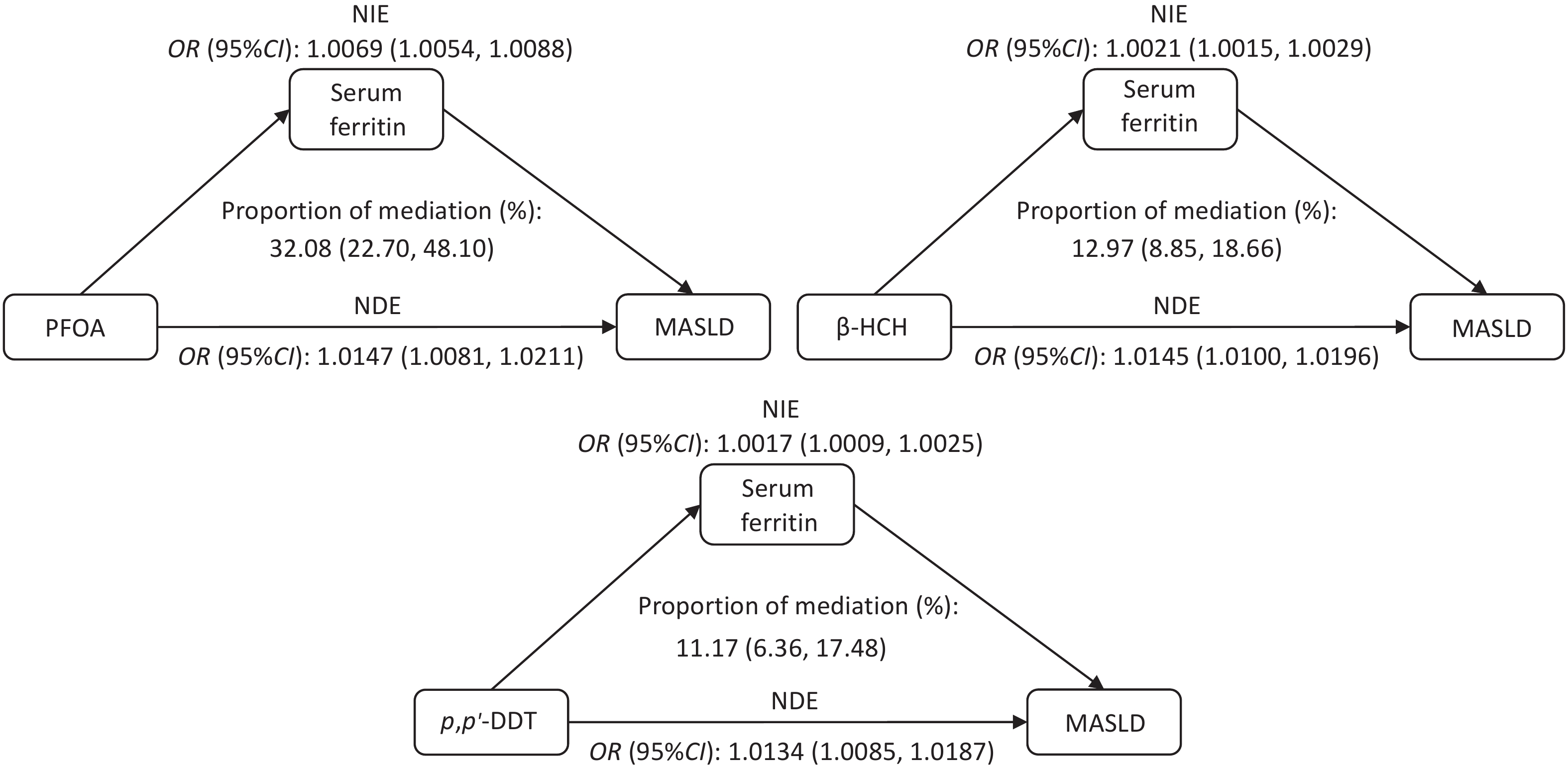
Based on predefined mediation criteria, PFOA, β-HCH, and p,p’-DDT were included in the mediation analysis (Supplementary Tables S9 and S10). Interaction tests between each EDC and SF showed no statistically significant interactions in either the overall population or stratified subgroup analyses (Supplementary Table S11). Therefore, mediation models were constructed without interaction terms. The mediation analysis showed that SF accounted for 32.08%, 12.97%, and 11.17% of the associations between each of PFOA, β-HCH, p,p′-DDT, and MASLD, respectively (Figure 3). In the stratified analysis, the mediation proportions ranged from 7.15% to 27.16% in males and 8.48% to 26.57% in females. Among young and middle-aged subgroups, SF played a crucial mediating role in the associations between PFOA (36.36%), β-HCH (21.48%), p,p’-DDT (16.28%), and MASLD, with mediating effects stronger than those observed in the overall population. In older adults, SF mediated 8.14% and 8.62% of the associations for β-HCH, p,p’-DDT, and MASLD (Supplementary Table S12).
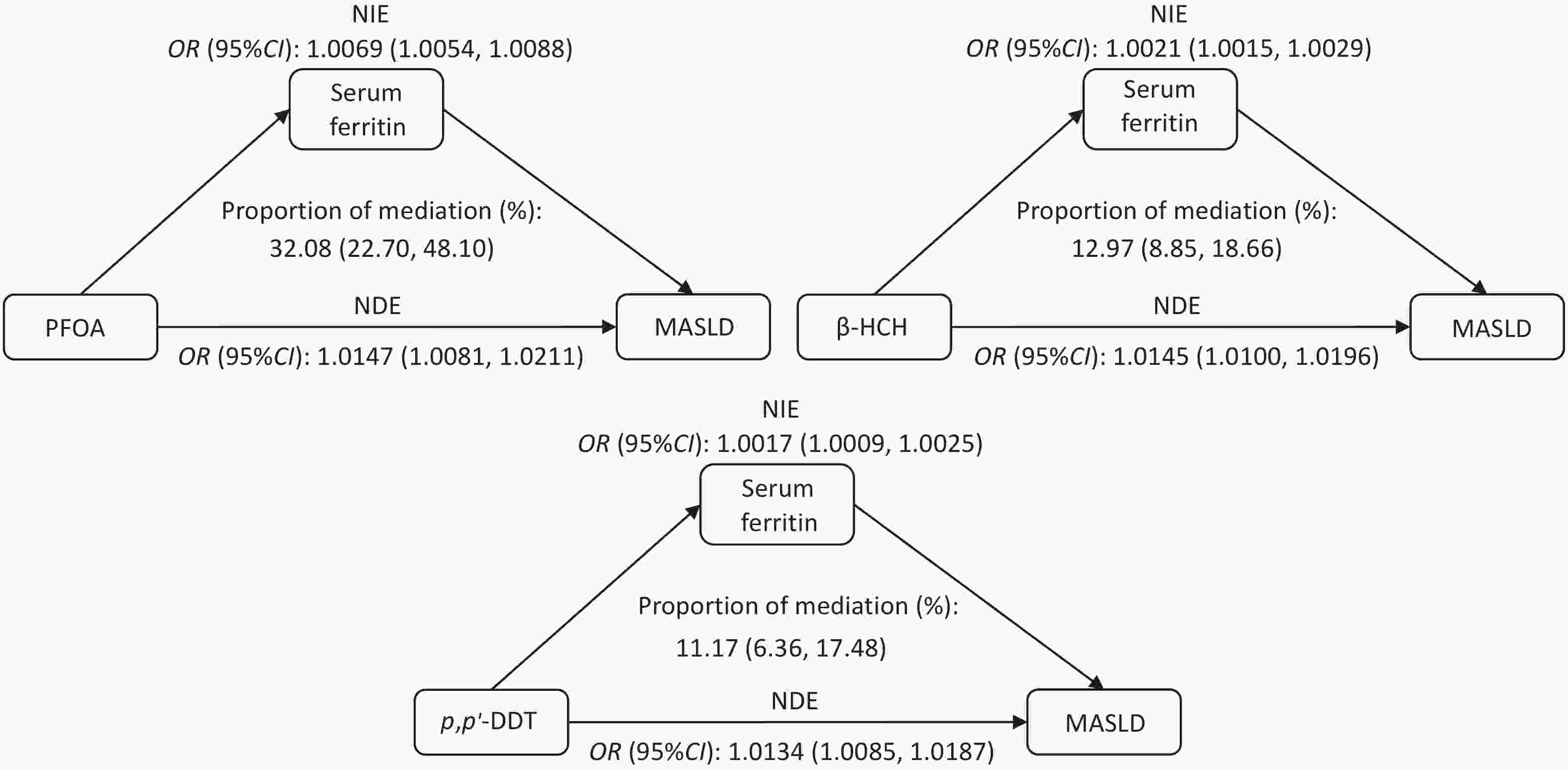
Figure 3. Mediation effects of serum ferritin (SF) in the association of key EDCs with the risk of risk. Abbreviations: EDCs, endocrine disrupting chemicals; MASLD, metabolic dysfunction-associated steatotic liver disease; NDE, natural direct effect; NIE, natural indirect effect; PFOA, perfluorooctanoic acid; β-HCH, β-hexachlorocyclohexane. The models were adjusted for age (continuous), residence (categorical), education (categorical), household income (categorical), smoking (binary), alcohol consumption (binary), physical activity (continuous), and total energy intake (continuous), fat intake (continuous), and cholesterol intakes (continuous).
-
The robustness of the findings was supported by three sensitivity analyses. After excluding individuals with EDC concentrations above the 99th percentile, the results remained consistent with the results of the primary analyses (Supplementary Table S13). When using data without multiple imputations for logistic regression analysis, the results were consistent with the main analysis (Supplementary Table S14). The QGC model results aligned with the mixed-effect results of the BKMR model, indicating that the mixed effects of key EDCs were significantly associated with the risk of MASLD (Supplementary Table S15).
-
This large, nationally representative cross-sectional study found that exposure to a mixture of common EDCs was associated with an increased risk of MASLD among Chinese adults. Two OCPs (β-HCH and p,p’-DDT), one phthalate (MEP), one PAH (ACE), and two PFASs (PFOA and PFPeA) were identified as key EDCs in the association between mixed EDC exposure and MASLD. The BKMR model further demonstrated that higher EDC mixture levels were associated with an increased risk of MASLD. In the stratified analysis, these findings were particularly strong in the male, young, and middle-aged groups. A key contribution of this study is the novel observation that SF may play a potential mediating role in the association between EDC exposure and MASLD, particularly in the young and middle-aged subgroups. Together, these results provide suggestive evidence and new hypotheses regarding the complex relationships among environmental exposure, iron metabolism, and liver health.
Most previous studies have focused on the association between a single EDC exposure and the risk of MASLD. Nonetheless, several studies have provided evidence supporting our understanding of the positive associations between three OCPs (p,p’-DDE, β-HCH, p,p’-DDT), four PFASs (PFOA, PFNA, PFHxS, PFOS), and one phthalate (MEP) and MASLD in single-exposure analyses[29,33–35]. Moreover, PFDoDA exhibited an inverse effect on MASLD risk at higher concentrations. This mechanism may be attributed to the ability of PFDoDA to repress the expression of pro-inflammatory cytokines, thereby attenuating liver injury[36]. However, single-exposure analysis cannot account for multiple simultaneous exposures and is therefore unable to reflect the actual exposure in the human body.
To address this limitation, we employed advanced mixture models to assess the combined effects of EDCs on MASLD by screening key EDCs and employing mixed-exposure models. These approaches better reflect real-world scenarios in which individuals are simultaneously exposed to multiple EDCs, enabling a more accurate assessment of their health impacts. To date, only one study in American adults has suggested that exposure to one or two classes of EDCs (heavy metals, PAE, or PFAS + PAE) is associated with an increased risk of MAFLD[33]. However, this study did not identify the key EDCs or explore the joint effects of multiple EDC classes. In contrast, our study initially included seven classes of EDCs and identified key EDCs from four of these. The combined effects of key EDCs, including two OCPs, one phthalate, one PAH, and two PFASs, were significantly associated with an increased risk of MASLD. Notably, ACE and PFPeA emerged as important contributors only in the mixture-based analyses, despite showing no significant individual association, highlighting the synergistic or joint effects of simultaneous EDC exposure and emphasizing the importance of using mixed exposure approaches[37].
The stratified analysis suggested notable sex and age differences in the relationship between EDC exposure and MASLD. Previous studies have found that older adults (> 65 years old) were more susceptible to associations between EDCs and MAFLD than young and middle-aged adults (< 65 years old)[33,38], which contrasts with our findings showing stronger associations in younger and middle-aged adults. Similarly, our observation of stronger associations in males differs from findings reported in American populations[33]. These discrepancies may reflect population-specific differences in exposure patterns, genetics, or lifestyle factors, as well as complex interactions between EDCs and age- and sex-specific hormone levels[14], and may influence the development of MASLD. In addition, PFPeA was associated with MASLD only among adults aged > 65 years. Given its relatively short half-life in the body[39,40], PFPeA may exert a more pronounced effect in older individuals, whose metabolic processes are less active.
To the best of our knowledge, this study is the first to provide nationally representative cross-sectional data suggesting a potential mediating role for SF in the association between EDCs and MASLD. Although previous studies have shown that EDCs can influence iron metabolism[21,22], the positive associations observed between PFOA, β-HCH, p,p’-DDT and SF levels are novel. Given that dysregulated iron metabolism is a known risk factor for liver disorders[17,41], and that elevated SF is linked to NAFLD[41,42], we investigated SF as a potential mediator. Our findings support this hypothesis, indicating that SF accounted for a significant proportion of the associations between PFOA, β-HCH, p,p’-DDT, and MASLD risk, implying a potential mediating pathway.
Previous evidence suggests that SF may mediate the relationship between EDCs and MASLD via various mechanisms. First, EDC exposure can induce inflammation and increase oxidative stress, thereby impairing liver function[43,44]. Within this inflammatory milieu, SF may act as a proinflammatory cytokine. Toxicological evidence suggests that SF amplifies the effects of EDCs, exacerbating metabolic disturbances in the liver[45]. Second, several studies have found that various EDCs can downregulate insulin receptor pathways, thereby undermining glucose metabolism in the liver[46,47]. This process may be enhanced by elevated SF levels[48,49], contributing to the development of MASLD. Finally, EDCs can affect the gut microbiota, disturbing normal metabolism and glucose homeostasis[50,51]. SF may exacerbate the effects of EDCs by influencing the microbiome composition and related transcriptomic characteristics of iron metabolism, thereby contributing to hepatic fat accumulation and increasing the prevalence of MASLD[20].
This study had several strengths. First, we used a large, nationally representative dataset to ensure the robustness of the conclusions. Second, we identified key EDCs using a WQS regression model and employed the BKMR model to assess the joint effects of key EDC mixtures on MASLD, thereby providing a more accurate reflection of real-world EDC exposure and its combined impact on liver health. Third, we examined potential differences in EDC effects on MASLD across age and sex groups to identify high-risk subgroups. Additionally, our study is the first to propose and provide preliminary support for iron metabolism—reflected by SF—as a plausible mediating pathway in the EDC-MASLD relationship, based on population data.
Despite these strengths, several limitations should be acknowledged. First, although our mixture analyses highlighted six EDCs with relatively greater influence in this dataset, the multifactorial nature of MASLD, together with the cross-sectional design, preclude estimation of population-attributable fractions or direct comparison of EDCs with all other risk factors in terms of causal contribution. Second, the cross-sectional design limits causal inference for both the observed associations between EDCs and MASLD and the proposed mediation effects of SF. Although our models were consistent with the mediating role of SF, longitudinal studies are required to establish temporal sequences and confirm these associations. Third, although SF is a valuable biomarker, its specificity is limited because it functions as an acute-phase reactant. Therefore, we interpreted the elevated SF levels in MASLD as a composite signal related to iron dysregulation and inflammation. Fourth, EDC exposure was assessed using serum concentrations only, which may not fully capture actual EDC exposure in the human body. Fifth, defining the MASLD status based on HSI values rather than ultrasound or biopsy results may have introduced a measurement bias into our findings. Additionally, owing to the absence of testing for viral hepatitis, individuals with secondary causes of hepatic steatosis could not be fully excluded, potentially introducing selection bias. Finally, as this study was conducted exclusively in the Chinese population, caution is warranted when extrapolating these findings to other ethnic groups.
-
Our study found positive associations between eight individual EDCs and the risk of MASLD. Specifically, we identified two OCPs (β-HCH and p,p’-DDT), one phthalate (MEP), one PAH (ACE), and two PFASs (PFOA and PFPeA) as key EDCs in the joint effect of EDC mixtures on MASLD, with higher levels of the key EDC mixtures significantly increasing the risk of MASLD. Males and individuals in the young and middle-aged subgroups may be more vulnerable to the effects of EDC exposure on MASLD. To the best of our knowledge, this study provides the first cross-sectional evidence from a nationally representative sample suggesting that SF mediates a significant proportion of the association between specific EDCs and MASLD. This novel finding suggests a mechanistic hypothesis linking EDC exposure to liver health that warrants confirmation through longitudinal studies. Our results highlight the importance of reducing exposure to key EDCs and underscore the need for further research on the role of iron metabolism in the pathogenesis of MASLD.
HTML
Study Population
Serum EDCs Measurement
Anthropometric and Laboratory Measurements
The Definition of MASLD
Covariates
Statistical Analysis
Univariate and Mixture-based Screening of Key EDCs
Joint Exposure Effects Analysis of Key EDCs on MASLD Risk
Stratified Analysis
Mediation Analysis
Sensitivity Analysis
Participant Characteristics
Association between Single EDC Exposure and MASLD
Selection of Key EDCs and their Mixed Effects on MASLD
Stratified Analysis
The Mediation Effect of SF on the Association of Key EDCs and MASLD
Sensitivity Analysis
Competing Interests The authors declare that they have no competing financial interests or personal relationships that may have influenced the work reported in this study.
Ethics This study was approved by the Ethics Committee of the Institute of Nutrition and Health of the Chinese Center for Disease Control and Prevention (No. 201524) and written informed consent was obtained from each participant.
Authors’ Contributions Conceptualization: Zongyao Li, Zhenyu Wu, Chang Su, Aidong Liu; Data curation: Zongyao Li, Huijun Wang, Yanzhen Hu; Formal analysis: Zongyao Li, Huijun Wang, Yanzhen Hu; Funding acquisition: Zhenyu Wu, Chang Su, Tao Zhang; Investigation: Yongbin Zhao, Xiaofan Zhang, Xi Kang, Chang Su, Aidong Liu; Methodology: Zongyao Li, Yongbin Zhao, Tao Zhang; Resources: Chang Su, Aidong Liu; Supervision: Zhenyu Wu, Tao Zhang, Aidong Liu; Validation: Zhenyu Wu, Huijun Wang, Yanzhen Hu, Xiaofan Zhang, Xi Kang; Visualization: Zongyao Li; Writing–original draft: Zongyao Li; Writing–review & editing: Yongbin Zhao, Tao Zhang
&These authors contributed equally to this work.

 Quick Links
 DownLoad: