




-
Among pathogens with the highest risk of causing the next pandemic, influenza viruses have diverse evolutionary branches and variants in the Orthomyxoviridae family[1,2]. They are classified into four types (A–D) based on nucleoprotein and matrix protein differences[3]. Influenza A and B viruses primarily cause seasonal influenza-related morbidity and mortality, posing significant public health problems worldwide[4]. Influenza A viruses infect diverse avian and mammalian hosts, whereas influenza B viruses are restricted to humans, a host limitation that considerably influences their long-term viability and risk of re-emergence[5]. The genetic variation of influenza B viruses in the late 20th century resulted in the emergence of two antigenically and genetically distinct lineages, represented by the prototype strains B/Victoria/2/1987 and B/Yamagata/16/1988[6]. Since their divergence, these two lineages have co-circulated globally while exhibiting distinct evolutionary processes and epidemiological characteristics. B/Victoria exhibited faster antigenic drift and more frequent lineage replacement, whereas B/Yamagata showed antigenic evolution at a slower rate[7]. These differences may affect population-level immunity and lineage-specific persistence capacity under sustained immunological pressure. Epidemiologically, these two lineages exhibit distinct infection patterns, particularly by age. B/Victoria infections are generally detected in children and teenagers, whereas B/Yamagata infections are more common in adults and older people, often leading to increased disease occurrence during B/Yamagata-dominant seasons[8]. Evidence of lineage-specific immune imprinting suggests that B/Yamagata survivors may be resistant to future infections. Recent serological research indicates that early-life influenza B exposure creates immunological biases that affect cross-reactivity with later virus strains[10]. Cohort-specific immunological profiles may reveal lineage-specific epidemiology and vulnerability. Population immunity or herd immunity refers to the cumulative immune protection across a population generated by prior infection and/or vaccination, which can reduce the risk of infection among susceptible individuals[11]. This barrier may be mediated by memory B cell-mediated recall, cross-reactive antibody, or lineage-specific immunological imprinting. Memory B cells quickly develop into antibody-secreting cells after re-exposure, establishing a universal antibody recall mechanism[12]. In influenza B, this general immune-barrier mechanism is further shaped by lineage-specific immune imprinting and asymmetric cross-lineage reactivity between B/Victoria and B/Yamagata[9,10]. Direct ecological displacement between B/Victoria and B/Yamagata is difficult to demonstrate. Evidence indicates that B/Victoria antigens can strongly recall immune responses primed by prior B/Yamagata exposure[13]. Vaccination may likewise induce asymmetric cross-lineage antibody responses[14]. Recent studies further demonstrate that B/Victoria infection can elicit neuraminidase-specific antibodies with cross-lineage protective activity against B/Yamagata, whereas reciprocal protection may be weaker[15]. Such asymmetric immunity may influence lineage-specific persistence, although its role in the apparent disappearance of B/Yamagata remains unclear. Nevertheless, lineage-specific patterns are key to understanding transmission dynamics and the depletion of population susceptibility.
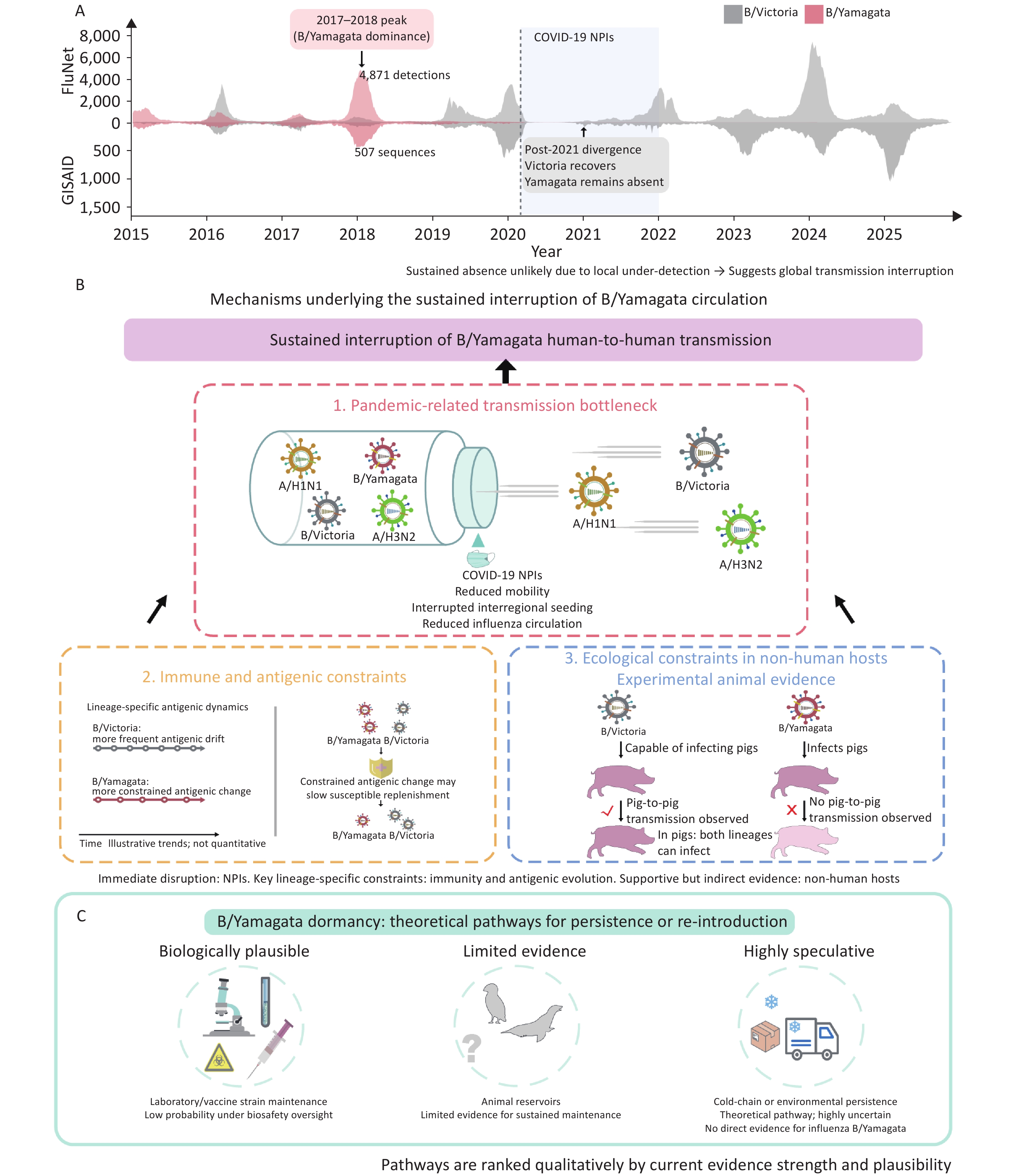
Global surveillance data indicate that the B/Yamagata circulation peaked during the 2017–2018 outbreak, but declined afterward. After 2019, the number of B/Yamagata detections and sequence submissions decreased significantly across all surveillance databases. Since March 2020, no laboratory-confirmed B/Yamagata cases have been reported through global influenza surveillance systems[16]. Subsequent infrequent detections were primarily caused by vaccine-related signals or laboratory artifacts. Analysis of detection data from the World Health Organization (WHO) Global Influenza Surveillance and Response System (FluNet) and 2015 to 2025 sequence submissions from the Global Initiative on Sharing All Influenza Data (GISAID) validated these trends (Figure 1A). During the 2017–2018 B/Yamagata-dominant season, weekly FluNet detections peaked at 4,871 in the week of January 15, 2018, whereas weekly GISAID HA sequences peaked at 507 sequences in the week of December 31, 2017. Subsequently, B/Yamagata detections and HA sequence submissions declined sharply after 2019. Both B lineages were suppressed during the coronavirus disease 2019 (COVID-19) pandemic. However, after 2021, B/Victoria resumed seasonal circulation, whereas B/Yamagata remained undetected[17]. Despite the return of influenza activity, B/Yamagata has remained absent for several years, suggesting that this prolonged absence cannot be explained by transient oscillations or regional under-detection. This pattern is more consistent with a major interruption of sustained human-to-human transmission. These historical and epidemiological observations provide essential context for evaluating the public health significance of B/Yamagata’s prolonged absence and understanding its implications for future influenza surveillance and vaccination strategies. Owing to this perspective, this study argues that the current evidence is most consistent with a dormancy-like state characterized by interruption of sustained human-to-human transmission, rather than definitive extinction or simple surveillance failure.
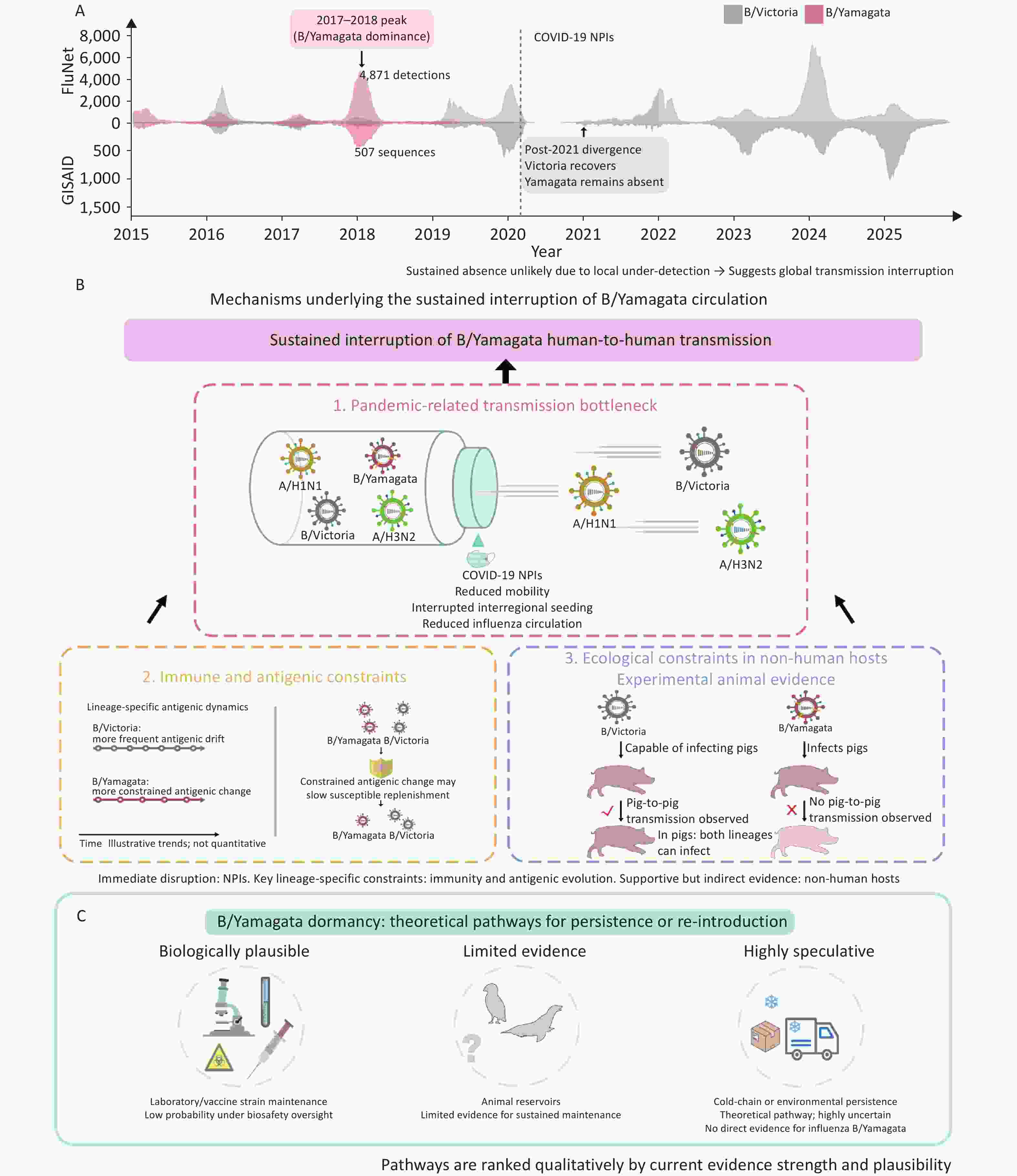
Figure 1. Diagram illustrating the epidemiological trends and suggested mechanisms that contributed to the decline of the B/Yamagata lineage, as well as its potential persistence or reintroduction pathways over time.
-
B/Yamagata’s steady decline in transmission cannot be traced to a single cause, although this is more likely the result of several factors working together. A hypothetical public health framework illustrating the interplay between monitoring deficiencies, immunological obstacles, and intervention-induced transmission bottlenecks affecting lineage-level circulation is presented in Figure 1B. The most direct disruptive factor was COVID-19-related non-pharmaceutical interventions (NPIs); however, B/Victoria circulation recovered after the same transmission bottleneck. Thus, lineage-specific immunological and antigenic traits may explain why B/Yamagata failed to re-establish circulation following the bottleneck. However, animal model studies cannot directly demonstrate reduced transmissibility in humans; therefore, evidence for ecological constraints in non-human hosts should be considered supportive rather than conclusive[18,19]. A recent conceptual mechanistic modeling study supports this interpretation, demonstrating that the B/Yamagata lineage's prolonged absence resulted from the combined effects of susceptible depletion following the 2017–2018 epidemic, limited antigenic evolution, and transmission bottlenecks related to the COVID-19 pandemic. The quantitative threshold effects indicated by the model imply that no single factor sufficiently accounts for the absence[17].
The prolonged absence of B/Yamagata may therefore reflect the combined effects of an acute transmission bottleneck, lineage-specific constraints related to population immunity and antigenic diversity, and ecological factors that further reduce the likelihood of persistence or reintroduction. Accordingly, the following section discusses these mechanisms in three parts: pandemic-related transmission disruption, immunological and antigenic barriers to re-establishment, and ecological constraints outside human populations.
-
During the COVID-19 pandemic, countries implemented strict NPIs such as social distancing, mask-wearing, travel restrictions, and school closures. These public health initiatives drastically reduced the duration of influenza transmission, creating a severe bottleneck in circulation.20 Chinese datasets show that influenza A (H3N2) activity, genetic diversity, and infection dynamics were affected from 2019 to 2022, whereas epidemic waves persisted under different public health settings.21 COVID-19 measures may have slowed the spread of the seasonal influenza virus. This may have had a greater impact on lineages with limited adaptive capacity, further reducing B/Yamagata’s ability to maintain sustained transmission.
-
B/Yamagata may have undergone more constrained antigenic evolution at the population level than B/Victoria prior to its disappearance in early 2020. This constrained antigenic pattern does not reflect reduced genetic evolutionary rates because both lineages exhibit comparable nucleotide substitution rates. Rather, it reflects lineage-specific antigenic dynamics and selection[22,23]. B/Yamagata viruses tend to accumulate fewer amino acid substitutions in antigenically relevant regions of hemagglutinin (HA) compared to B/Victoria, which may reduce antigenic novelty and opportunities for immune escape[17]. This constrained antigenic variation may sustain population-level immune protection generated by prior infection and vaccination, thereby limiting effective susceptibility[11]. Beyond HA-centered immune responses, neuraminidase (NA)-mediated immunity may also contribute to broader protective immunity[24,25]. Anti-NA immunity reduces disease severity, decreases viral titers, and reduces viral shedding[26]; Moreover, experimental vaccine-challenge studies confirm that NA-matched immunity reduces disease burden[24]. NA-specific antibodies can contribute to broader cross-reactive influenza protection[25]. By contrast, B/Victoria has shown more frequent antigenic drift and lineage turnover, a pattern consistent with greater antigenic novelty and sustained circulation in human populations[7,22]. Overall, lineage-specific antigenic dynamics and NA-mediated immune protection may constrain population-level immunity and susceptibility, thereby limiting the opportunity for B/Yamagata to re-establish circulation.
-
Influenza B viruses have been detected in several non-human species, including birds, marine animals, and dogs[27]. A study using a guinea pig model showed that influenza B viruses, particularly the B/Yamagata lineage, can infect and spread amongst guinea pigs. Such infections result in productive replication in the lower respiratory tract and associated pathological changes[18]. By contrast, with pig model studies, both influenza B lineages infected pigs, but only B/Victoria was capable of pig-to-pig transmission. Meanwhile, B/Yamagata demonstrated no inter-pig transmission.19 Thus, B/Yamagata faces increased ecological constraints beyond the human population, therefore limiting opportunities for long-term survival or cryptic transmission. Although these animal studies require cautious interpretation, they suggest that B/Yamagata faces greater ecological constraints than B/Victoria in non-human populations, potentially impeding its long-term persistence or reintroduction. Influenza B virus infection has been reported in seals, whereas experimental studies in dogs failed to prove productive influenza B infection, suggesting that evidence for sustained non-human reservoirs remains limited[28,29]. Therefore, these findings, together with guinea pig and pig model studies, should be interpreted cautiously, as they do not constitute direct evidence of differential transmissibility in humans. Nevertheless, they suggest that ecological constraints in non-human populations may further limit the persistence or reintroduction potential of B/Yamagata.
-
Although B/Yamagata has not been detected globally for nearly 6 consecutive years, claims of its complete elimination warrant caution owing to potential limitations in existing surveillance sensitivity and geographic coverage. Sporadic detections, occasionally linked to vaccination administration or laboratory misreporting[16], also underscore the need for cautious interpretation of current monitoring data. Seasonal influenza viruses usually circulate through global transmission networks, and phylogeographic analyses have shown that influenza B viruses, although differing from A/H3N2, still display regional circulation and interregional spread[30]. This framework is essential for interpreting the prolonged non-detection of B/Yamagata. Local surveillance gaps or brief cryptic circulation cannot be entirely ruled out. However, several years of silent circulation of B/Yamagata would be expected to yield occasional detections, sequence submissions, or evidence of geographic spread. Therefore, the sustained global absence of laboratory-confirmed B/Yamagata makes long-term isolated human circulation unlikely and is more consistent with a major interruption of sustained human-to-human transmission. Consequently, public health decisions should be reached cautiously, especially within such an uncertain framework.
Moreover, if B/Yamagata vanishes from the human population, several hypothesized pathways remain relevant to risk assessment and preparedness, including laboratory or vaccine strain maintenance, unidentified animal hosts, and cold-chain or environmental persistence (Figure 1C). These pathways differ substantially in evidence strength and biological plausibility: laboratory or vaccine strain maintenance is biologically feasible but unlikely given current biosafety oversight; unidentified animal hosts remain possible but unconfirmed; and cold-chain or environmental persistence lacks direct evidence and remains highly speculative. First, B/Yamagata strains are preserved in laboratories and vaccine facilities worldwide. Thus, global public health systems must strengthen biosafety management, standardize risk assessments of laboratory-preserved strains, and improve emergency response plans for likely laboratory-related disasters as part of risk-based preparedness planning. Second, although B/Yamagata exhibits lower transmissibility in laboratory animals than B/Victoria, its ability to infect animals in natural habitats has not been fully assessed. Unidentified natural reservoirs of B/Yamagata may provide potential pathways for future re-emergence[28,29]. Finally, given that cold-chain conditions are recognized as a potential pathway for pathogen introduction and preservation in cold-chain-based epidemiology[31], the possibility that B/Yamagata could persist through cold-chain-associated channels cannot be completely ruled out. No direct evidence currently supports B/Yamagata’s persistence or reintroduction into human populations through cold-chain routes; hence, this pathway is highly speculative and less supported than laboratory strain maintenance or unidentified animal-host scenarios.
Population serological tests indicate that despite B/Yamagata’s sustained absence globally since 2020, specific antibody levels for this lineage have not drastically declined, suggesting a persistent level of humoral immunity within the population[32]. However, this immunity may temporarily originate from the cross-reactivity to B/Victoria[15,33]. Owing to the implausibility of infection and the absence of a key component in the quadrivalent vaccine, the immune memory of specific lineages in younger generations may slowly decline. Over time, B/Yamagata may undergo modifications at essential antigenic sites and partially circumvent existing population immunity defenses. If this lineage is not truly extinct, a prolonged lack of immune stimulation may exacerbate the deficiencies of the population's immune barrier,34 thereby facilitating its future re-emergence.
Future preventative measures should focus on several key areas. First, strengthening molecular epidemiological and serological surveillance systems through enhanced sensitivity and broader geographic coverage, particularly in underserved regions, would help reduce the risk of undetected B/Yamagata circulation. Second, the consensus on formulation of the influenza vaccine requires extreme caution and sufficient adaptability to permit expedited revisions to the vaccine composition, as necessary[16,34]. On February 27, 2026, the WHO recommended influenza vaccine composition for the 2026–2027 Northern Hemisphere season without inclusion of the B/Yamagata lineage component, reflecting its sustained global absence while acknowledging ongoing uncertainties.35 Insights from avian influenza A(H7N9), which has evolved from low-pathogenic to highly pathogenic variants, suggest a potential for rapid escalation of influenza risk and emphasize the necessity for ongoing surveillance and risk-based preparedness strategies[36]. Finally, research on universal influenza vaccines and drugs covering B/Yamagata should be further strengthened to prepare for a potential future re-emergence[37,38]. From a public health perspective, the prolonged global absence of B/Yamagata represents an atypical natural experiment that reveals insights into how surveillance systems, vaccination initiatives, and preparedness frameworks respond to the lineage-specific modifications in endemic illnesses. For future management of influenza and vaccine strategies, distinguishing between real extinction, long dormancy, and gaps in surveillance is important. These criteria are relevant to global risk assessment, resource allocation, and the improvement of international health governance for the prevention and control of influenza.
-
In summary, B/Yamagata should be framed as a dormant lineage rather than as definitively extinct or simply overlooked by surveillance. Localized re-emergence is highly unlikely, although biologically plausible. A dormancy-based paradigm incorporating surveillance data, population immunity, antigenic evolution, ecological constraints, and reintroduction barriers is central to this perspective. Current evidence supports a multifactorial explanation, with NPIs acting as the immediate disruption, while immune–antigenic constraints shape post-bottleneck recovery[17]. Genetic and serological monitoring, investigation of probable non-human reservoirs, biosafety management of conserved B/Yamagata strains, and adaptive vaccine strategy are required to distinguish extinction from prolonged dormancy.
HTML
Prevalence History of the B/Yamagata Lineage
Ecological and Public Health Factors Affecting the Ongoing Halt of B/Yamagata Circulation
1. NPIs during the Pandemic: An Immediate but Incomplete Explanation
2. Immunological and Antigenic Barriers to B/Yamagata Reestablishment
3. Supporting Evidence of Non-Human Ecological Limits
Perspectives on the Risk of Future Outbreaks
B/Yamagata Dormancy and Future Priorities
Competing Interests The authors declare that they have no competing interests.
Ethics Not applicable.
Authors’ Contributions The study was proposed and conceived by GFG and JL. All the authors contributed to data review, initial manuscript drafting, and revisions. All the authors approved the final version of the manuscript.
Data Sharing The surveillance data discussed in this article were obtained from the World Health Organization’s FluNet, and influenza sequence metadata were accessed through the Global Initiative on Sharing All Influenza Data in accordance with its data-access terms. No new experimental datasets were generated for this study.
Reference

 Quick Links
 DownLoad: