





-
Pain is a major global public health concern and one of the leading contributors to disability[1]. Beyond its direct effects on physical health, chronic pain substantially impairs functional status, reduces quality of life, and increases psychological distress[2]. Many factors are associated with pain occurrence, including age, chronic disease status, and unhealthy lifestyle behaviors[3,4]. However, environmental determinants of pain remain insufficiently understood. Experimental and epidemiological evidence suggests that low temperature may aggravate pain through several mechanisms, including vasoconstriction, increased blood viscosity, and sympathetic nervous system activation[5]. Nevertheless, existing studies have largely focused on specific pain types, such as musculoskeletal symptoms or chest pain, and comprehensive evaluations across multiple pain outcomes remain limited.
Growing evidence in environmental epidemiology indicates that season-specific temperature patterns are critical exposure dimensions. Stratified analyses for cold season and warm season are therefore needed to better characterize associations between temperature and pain across different health conditions. Using data from the China Health and Retirement Longitudinal Study (CHARLS), a nationally representative survey of the Chinese population, this study investigated the associations of average temperatures during cold and warm seasons with multiple pain types among middle-aged and older adults.
CHARLS was designed to obtain a high-quality, nationally representative sample of Chinese residents aged 45 years or older and to provide data for scientific research on population aging. The present study used cross-sectional data from the 2018 CHARLS wave, which covered 150 counties or districts across mainland China. All participants provided written informed consent before participation. The Institutional Review Board at Peking University approved all survey procedures (IRB00001052-11015). All procedures were conducted in accordance with the Declaration of Helsinki. The CHARLS website (
https://charls.pku.edu.cn/ ) provides public access to the data.Daily mean ambient temperature data for 2018 were obtained for each city from the China Meteorological Data Sharing Service System (
http://data.cma.cn/ ). Seasonal average temperatures were calculated at the city level from daily mean temperatures; the cold season was defined as October to March, and the warm season was defined as April to September. Participants’ residential locations were geocoded and linked to the corresponding city-level temperature data. All individuals residing at the same study site were assigned identical ambient temperature exposure values for both cold and warm seasons.Chronic pain was assessed by self-report. Participants were asked whether they had experienced long-term chronic pain and where the pain was located. Reported locations included headache, neck pain, shoulder pain, arm pain, wrist pain, finger pain, chest pain, stomachache, back pain, waist pain, buttock pain, leg pain, knee pain, ankle pain, and toe pain. Except for headache, chest pain, and stomachache, pain at other anatomical sites was grouped as musculoskeletal pain, including pain in the neck, shoulder, arm, wrist, fingers, back, waist, buttock, leg, knees, ankle, and toes[6].
We used Cox regression with a constant time variable assigned to all individuals and robust variance estimates to evaluate the associations between ambient temperature exposure and pain prevalence and to obtain prevalence ratios (PRs) with 95% confidence intervals (CIs). Average temperatures during the cold and warm seasons were categorized into quintiles. Quintiles were modeled as an ordinal variable coded 1–5 to estimate PRs per one-quintile increment. Categorical models were also fitted to estimate PRs for quintiles 2–5 relative to quintile 1. Covariates included age, sex, urban or rural residence, educational attainment, marital status, insurance type, smoking status, drinking status, nighttime sleep duration, dyslipidemia status, and diabetes status. To characterize the relationships between average temperature and each pain type, we fitted the same Cox regression model with restricted cubic splines for average temperature, using three knots at the 5th, 50th, and 95th percentiles, with the lowest value as the reference. All analyses were conducted using R version 4.4.0 (R Foundation for Statistical Computing, Vienna, Austria)[7]. A two-sided P < 0.05 was considered statistically significant.
In the 2018 CHARLS survey, 19,816 participants were initially enrolled. After excluding individuals aged < 45 years (n = 235), those without pain information (n = 76), and those with a history of cancer (n = 258), 19,247 participants were included in the final analysis (Supplementary Figure S1). Participants were further classified into subgroups according to disease status relevant to each pain outcome. Specifically, analyses were conducted according to the presence or absence of stroke and hypertension for headache, heart attack, chronic lung diseases and asthma for chest pain, stomach and liver diseases for stomachache, and arthritis for musculoskeletal pain.
Ambient temperature varied substantially across study sites. Average temperatures during both cold and warm seasons showed wide distributions across participants (Supplementary Figure S2A, B). Participant distributions across quintiles of average temperature during the cold and warm seasons are shown in Supplementary Figure S2C, D. The mean participant age was (62.0 ± 10.2) years, and 52.3% of participants were women. Baseline characteristics according to quintiles of average temperature during the cold and warm seasons are presented in Supplementary Tables S1 and S2. Most characteristics differed significantly across temperature quintiles. Participants in higher temperature quintiles tended to be slightly older, had lower educational attainment, were less likely to be current smokers, and had a lower prevalence of dyslipidemia.
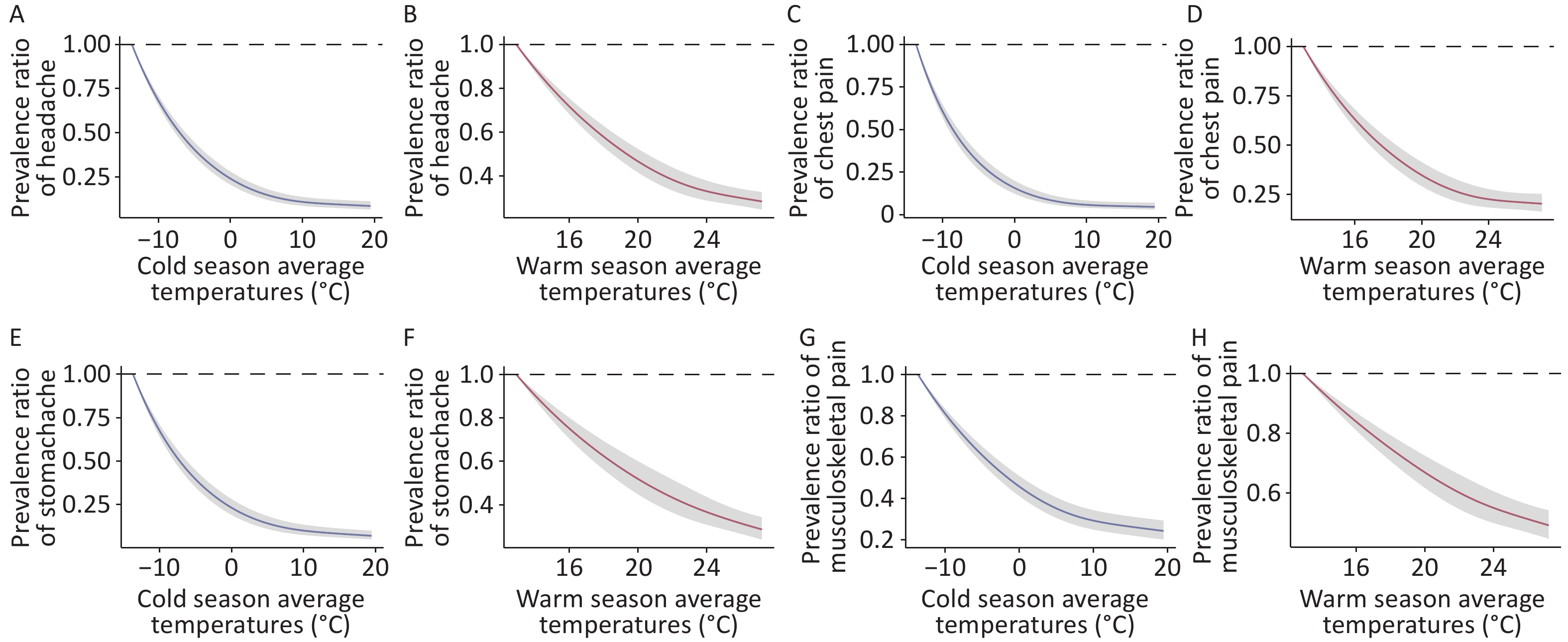
Our findings showed that lower ambient temperatures were consistently associated with a higher prevalence of headache, chest pain, stomachache, and musculoskeletal pain among participants without specific diseases (Figure 1). All spline curves showed monotonic inverse associations between temperature and pain prevalence. The decline in pain prevalence was steeper at lower temperature ranges, particularly during the cold season.
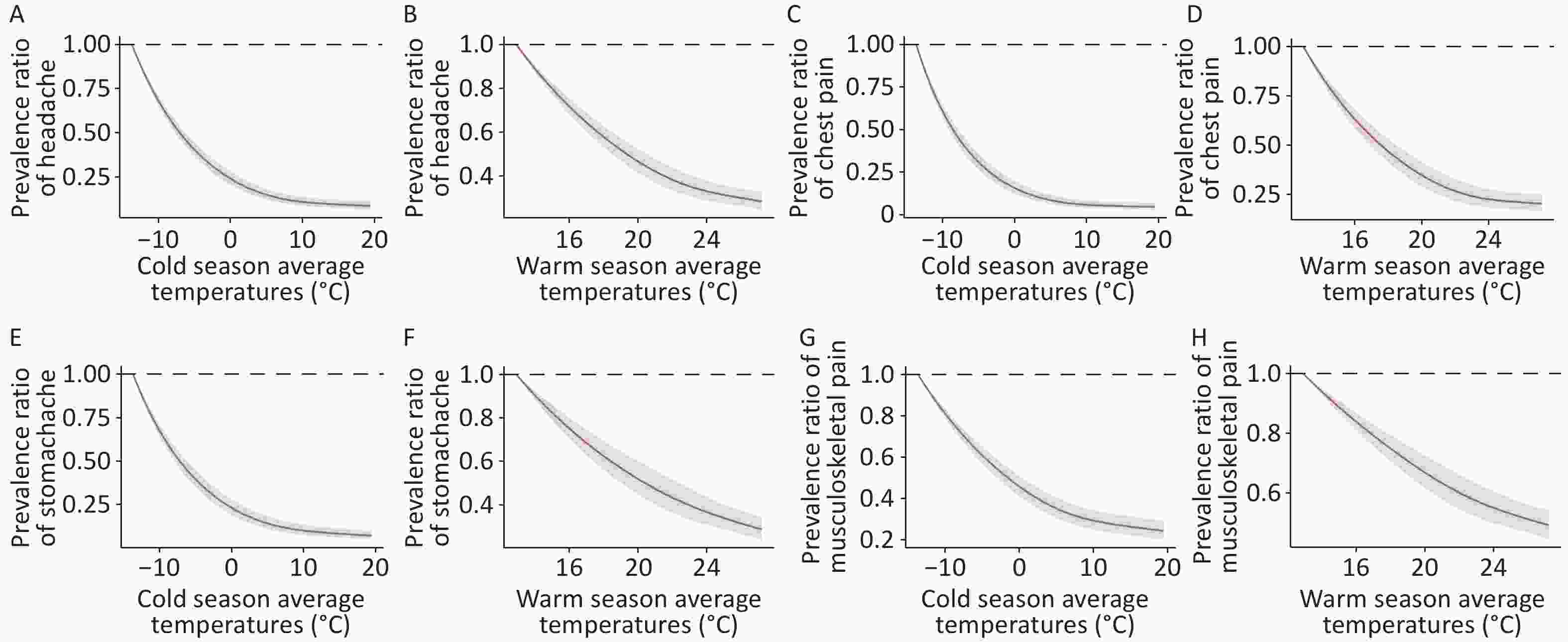
Figure 1. Spline curves showing the associations of average temperature during the cold season (A, C, E, and G) and warm season (B, D, F, and H) with different pain types among participants without specific diseases. Panels A and B show headache analyses among participants without stroke or hypertension; panels C and D show chest pain analyses among participants without heart attack, chronic lung disease, or asthma; panels E and F show stomachache analyses among participants without stomach or liver disease; and panels G and H show musculoskeletal pain analyses among participants without arthritis. Ambient temperature is modeled as a smooth term using restricted cubic splines with three knots. Shading indicates 95% confidence intervals (CIs). The lowest ambient temperature level is used as the reference. Models are adjusted for age, sex, urban or rural residence, educational attainment, marital status, insurance type, smoking status, drinking status, nighttime sleep duration, dyslipidemia status, diabetes status, and warm season average temperature (for cold season temperature analysis) and cold season average temperature (for warm season temperature analysis).
Across models, each increase in temperature quintile was associated with lower pain prevalence, with generally stronger associations during the cold season (Table 1). Per-quintile average temperature was negatively associated with headache prevalence during the cold season (PR = 0.78; 95% CI = 0.75–0.80) and warm season (PR = 0.88; 95% CI = 0.86–0.90), and chest pain prevalence during the cold season (PR = 0.72; 95% CI = 0.68–0.76) and warm season (PR = 0.83; 95% CI = 0.80–0.86). Per-quintile average temperature was also negatively associated with stomachache prevalence during the cold season (PR = 0.77; 95% CI = 0.73–0.80) and warm season (PR = 0.88; 95% CI = 0.85–0.90), and musculoskeletal pain prevalence during the cold season (PR = 0.87; 95% CI = 0.85–0.89) and warm season (PR = 0.93; 95% CI = 0.92–0.95).
Categorical analyses further supported these findings (Table 2). Compared with participants in the lowest average-temperature quintile, participants in quintiles 2–5 had lower PRs for headache, chest pain, stomachache, and musculoskeletal pain in fully adjusted models. All PRs were below 1 and were smaller during the cold season, indicating stronger associations than those observed during the warm season. Given population aging and the projected increase in chronic pain prevalence, effective cold protection may be needed for people living in cold areas and those working in cold environments.
Nearly 30 years ago, a study had compared the prevalence of low back pain among workers exposed to cold conditions with that among workers in normal-temperature environments[8]. The prevalence of low back pain was 46% among workers in low-temperature stores (−20 to −15 °C), 24% among workers exposed to cold water, 19% among workers in ice stores (−10 °C), and 3% among workers in normal-temperature environments (3–10 °C). Recently, a time-stratified case-crossover study of low ambient temperature and incident myocardial infarction (MI) reported that extremely low temperatures were associated with a higher risk of MI, particularly among individuals older than 65 years[9]. In the present study, we observed similar associations between low temperatures and chest pain. Although chest pain is a typical symptom of MI, some chest pain cases in our study may have reflected underlying cardiovascular events that were not directly captured.
For each pain type, participants were classified according to the presence or absence of specific diseases, such as hypertension or stroke. Among participants with specific diseases, similar inverse associations were observed in spline curves and categorical analyses (Supplementary Figure S3 and Supplementary Tables S3 and S4), further supporting the robustness of the findings. Previous evidence suggests that exposure to lower temperatures is associated with increased sympathetic nervous system activation, vasoconstriction, and reduced endothelial function, which may contribute to higher blood pressure and stroke risk[10]. Accordingly, among participants with hypertension or stroke, the observed associations between lower temperature and headache may partly reflect underlying disease-related susceptibility. However, significant associations between lower temperature and headache prevalence were also observed among participants without specific diseases associated with pain symptoms. These findings suggest that the relationship between temperature and pain may not be fully explained by pre-existing conditions.
A key strength of this study is its nationwide, multistage sampling design across mainland China, which ensured geographic diversity in ambient temperature exposure. However, several limitations should be acknowledged. First, the cross-sectional design precluded causal inference regarding the associations between temperature exposure and pain. Second, temperature data were available only at the area level; therefore, individual-level exposure variability, including indoor temperature conditions, could not be captured. Third, pain assessment relied on self-reported information without standardized measurement scales, which may have introduced reporting bias. Finally, residual confounding by unmeasured factors may have influenced the observed associations.
In conclusion, this study suggests that lower temperatures are associated with a higher prevalence of headache, chest pain, stomachache, and musculoskeletal pain among middle-aged and older adults during both cold and warm seasons and among participants with and without conditions related to pain. However, because of the cross-sectional study design, these associations should be interpreted cautiously and should not be considered causal.
HTML
Competing Interests The authors declare no conflicts of interest related to this work.
Ethics CHARLS was approved by the Institutional Review Board at Peking University (IRB00001052-11015), and written informed consent was obtained from all participants.
Authors’ Contributions YL, MY, and JZ contributed to the conception and design of the study. YL, FW, and MDZ drafted the original manuscript. YL and MDZ contributed to visualization. MDZ contributed to software. YL and FW contributed to methodology and data curation. YL conducted the investigation. YJ, MY, and JZ reviewed and edited the manuscript. JZ and MY supervised the study and contributed to project administration and conceptualization. All authors read and approved the final manuscript.
Data Sharing The data can be requested from Ye Luo and Junpeng Zhu, and can also be downloaded from
&These authors contributed equally to this work.
Reference

 Quick Links
 DownLoad: