


-
Cardiovascular diseases (CVDs) impose heavy disease burden and are the leading cause of mortality and morbidity worldwide. The number of patients with CVD has exceeded 500 million worldwide, with 330 million in China, including 245 million patients with hypertension, 11.39 million with coronary heart disease (CHD), and 8.9 million with heart failure (HF)[1]. In recent years, the annual incidence and mortality rates have shown an increasing trend, posing a significant threat to human health. Delayed recognition of CVD can postpone diagnosis and intervention. Many people with hypertension remain undiagnosed[2]; myocardial infarction may be clinically unrecognized and is associated with increased mortality risk[3]; and opportunities to identify and manage HF may be missed before a first hospitalization[4]. These findings underscore the importance of timely detection and intervention. CVD not only has a high mortality rate but also causes long-term complications (such as chronic kidney disease and cognitive dysfunction) that severely impair patients' quality of life. These problems have led to a heavy socioeconomic burden. Therefore, effective early identification and precise intervention for CVD have become a global research hotspot.
Clinical decision support systems (CDSS) are auxiliary tools that integrate patient information, medical knowledge, and intelligent algorithms to provide personalized diagnosis and treatment recommendations. CDSS can support chronic disease management and the identification of cardiovascular risk by integrating clinical information, guiding medication decisions, and facilitating collaboration[5-7]. It is particularly noteworthy that traditional Chinese medicine (TCM) clinical decision support systems (TCM-CDSS), important tools for the inheritance and innovative development of TCM, have received increasing attention[8-10]. The 2019 "Opinions of the Central Committee of the Communist Party of China and the State Council on Promoting the Inheritance and Innovative Development of TCM" proposed encouraging TCM hospitals to develop intelligent TCM auxiliary diagnosis and treatment systems, integrating medical big data with TCM disease and syndrome information, constructing a TCM-CDSS, and promoting online and offline integrated services in hospitals. TCM-CDSS provides "individualized diagnosis and treatment according to person and time" for CVDs by integrating the four diagnostic methods of TCM: "inspection, auscultation and olfaction, inquiry, and palpation", along with syndrome differentiation and treatment theory, TCM knowledge base, and renowned TCM experts' experience, thereby demonstrating unique advantages in the long-term management of chronic diseases such as hypertension. TCM-CDSS supports disease and syndrome differentiation, applies shared treatment principles across different diseases when appropriate, recommends Chinese herbal prescriptions, and assists in formulating TCM treatment plans[8-11]. In recent years, by integrating ancient TCM literature, renowned TCM experts' experience, and clinical medical record data combined with artificial intelligence (AI) technologies such as natural language processing, knowledge graphs, and deep learning, the TCM-CDSS has made important progress in the syndrome differentiation of CVDs such as hypertension and CHD, Chinese herbal compatibility optimization, and individualized treatment[12-14].
As medical knowledge and computing methods develop, CDSS is being applied across cardiovascular care to support diagnosis, treatment recommendations, and risk assessment. However, reviews of cardiovascular CDSS have given limited attention to an integrated Chinese and Western medicine perspective, particularly in-depth discussion on the development history, technical characteristics, and application value of the integrative Chinese and Western medicine clinical decision support systems (ICWM-CDSS). Therefore, this article systematically and comprehensively reviews the research progress, application effectiveness, existing problems, and future prospects of CDSS in cardiovascular fields, such as hypertension, CHD, HF, arrhythmia, and myocardial infarction, with special emphasis on the unique role and innovative value of TCM-CDSSs in CVD management, with an aim to provide a reference for improving the precision diagnosis and treatment level of CDSS and a scientific basis for promoting new paradigms for integrative Chinese and Western medicine prevention and treatment of CVDs.
To construct this new paradigm and explicitly align it with the core concepts presented in our title, this review adopts a conceptual framework of dual-track parallel and integrated innovation. In this context, dual-track parallel refers to the concurrent but independent developmental trajectories of Western medicine CDSS and TCM-CDSSs, as they currently address clinical needs from different theoretical standpoints. Integrated innovation signifies an anticipated future paradigm: a profound amalgamation of Chinese and Western medicine across underlying knowledge systems, algorithmic models, and clinical pathways, creating a unified and synergistic approach to CVD management (Figure 1).
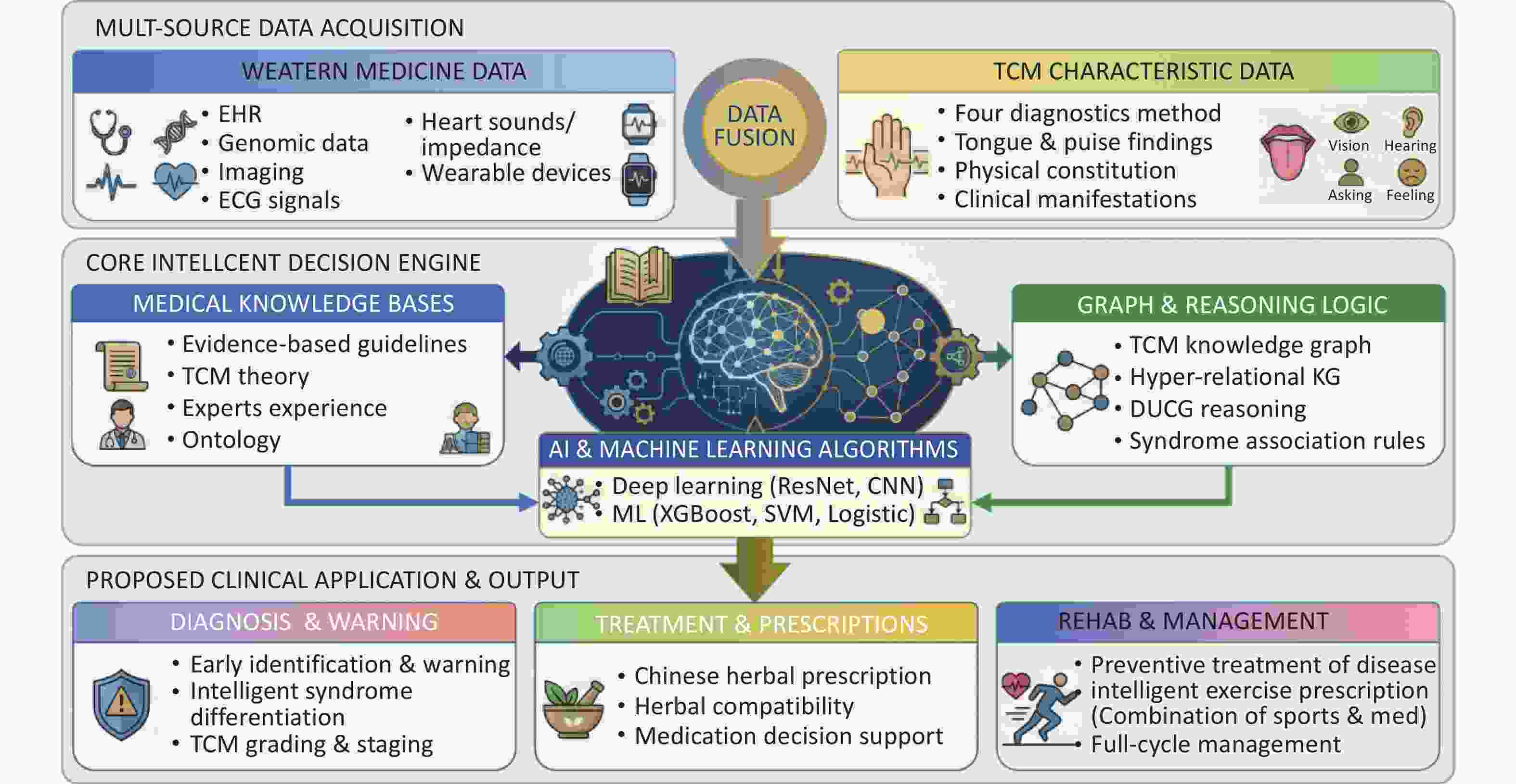
Figure 1. Proposed integration architecture of an integrative Chinese and Western medicine CDSS for cardiovascular diseases. The three layers link multisource data acquisition and fusion, a knowledge-informed decision engine, and proposed clinical applications. The diagram is a conceptual framework, not a validated single system; clinical benefits and medication recommendations require direct evaluation and clinician oversight. CDSS, clinical decision support system; TCM, traditional Chinese medicine; EHR, electronic health record; ECG, electrocardiogram; AI, artificial intelligence; ML, machine learning; KG, knowledge graph; DUCG, dynamic uncertain causality graph; ResNet, residual neural network; CNN, convolutional neural network; XGBoost, extreme gradient boosting; SVM, support vector machine.
-
To ensure methodological transparency, the literature search and screening process for this review were conducted with reference to the Preferred Reporting Items for Systematic Reviews and Meta-Analyses (PRISMA) guidelines. A comprehensive search was performed across authoritative Chinese and English databases, including PubMed, Web of Science (WOS), China National Knowledge Infrastructure (CNKI), and Wanfang Data. The original database search covered inception to November 2025. For this revision, targeted supplementary reference searches extended publication coverage to January 27, 2026, including online-first publications. The search strategy used a combination of Boolean logic (AND, OR) and specific screening conditions (such as themes, abstracts, and keywords) to ensure comprehensiveness and precision. English search keywords included "clinical decision support system", "machine learning", and "Traditional Chinese Medicine"; Chinese thematic words included "Traditional Chinese Medicine," "artificial intelligence," and "decision support system."
-
Studies were considered eligible based on the following inclusion criteria: (1) studies involving CDSS and their applications in integrated TCM and Western Medicine, or exclusively in Western Medicine; (2) publications in either Chinese or English; and (3) studies containing complete bibliographic information, such as authors, institutions, and keywords.
The exclusion criteria were as follows: (1) studies without an accessible full text, (2) studies with duplicate data or content irrelevant to the theme (including letters, reports, newspapers, etc.), and (3) studies targeting non-humans, such as animal experiments.
-
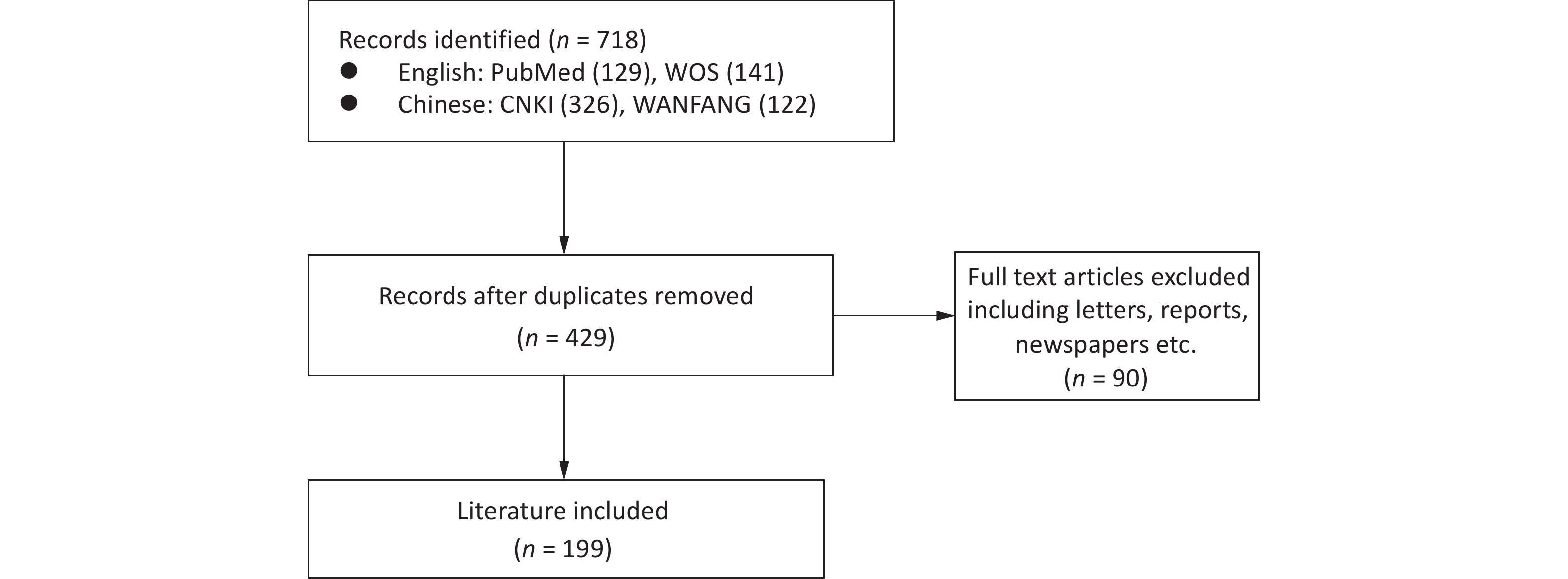
Two researchers independently conducted literature screening and data extraction, and subsequently cross-verified the extracted data to ensure accuracy. Initially, 718 records were identified (270 from English databases and 448 from Chinese databases). After removing the duplicates, 429 records remained. Following a rigorous full-text screening process, which excluded 90 items such as letters, reports, and newspapers, 199 foundational research articles were ultimately included in the analysis. A detailed flowchart illustrating the literature screening process is shown in Figure 2.
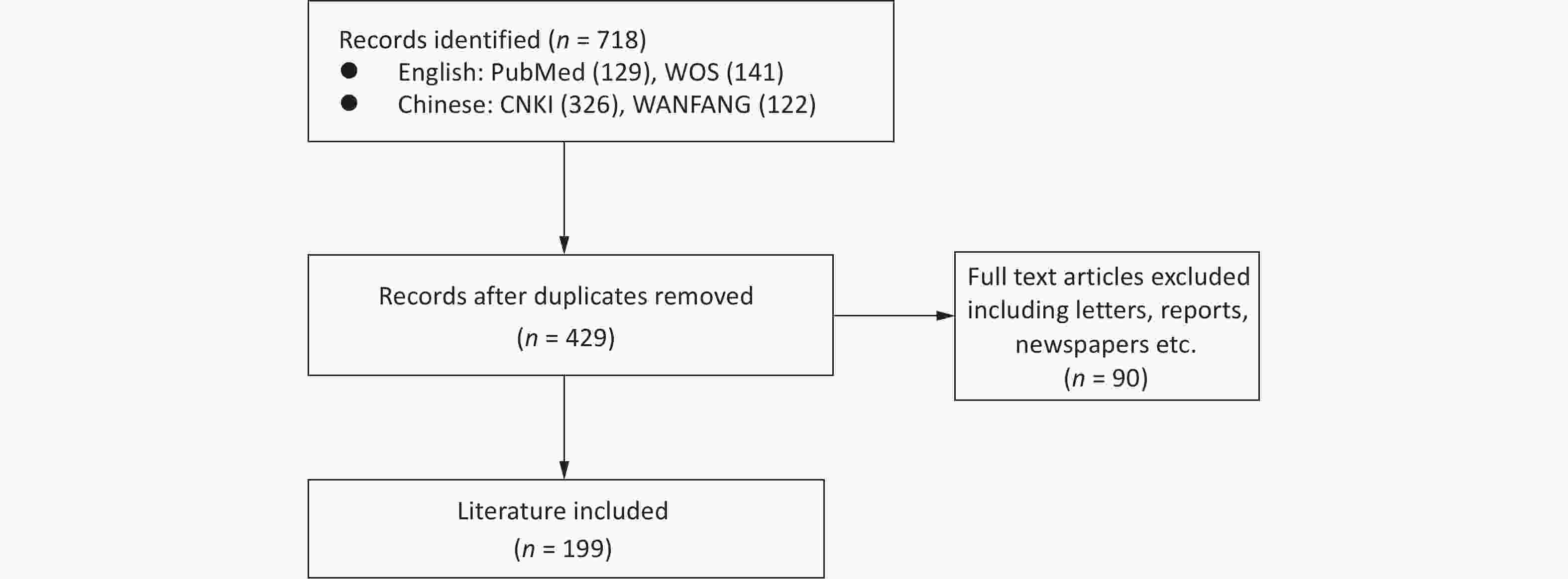
Figure 2. Literature screening process. WOS, Web of Science; CNKI, China National Knowledge Infrastructure; n, number of records. Wanfang Data is a database name. The counts refer to the original search and screening process.
-
Hypertension is a syndrome characterized by elevated systemic arterial blood pressure and is one of the leading causes of death worldwide. Research on hypertension CDSS accounts for the highest proportion of all cardiovascular CDSS, and its development can be divided into three stages, with the integration of TCM-CDSS in recent years opening new paths for hypertension management.
The first stage was primarily knowledge base construction and technology exploration (2007–2014), the core of which was the construction of structured knowledge bases. In 2007, Kim[15] first adopted ontology technology to transform the World Health Organization (WHO) hypertension guidelines into a machine-readable format, laying a methodological foundation for subsequent research. In 2012, Thompson[16] evaluated a CDSS for blood pressure management in patients undergoing hemodialysis; the before-and-after study did not demonstrate a significant improvement in blood pressure control. In 2014, Park[17] implemented an ontology-based CDSS for hypertension management incorporating drug-diet interactions; the system received a mean evaluation score of 4.60 out of 5. The second stage focused on community validation and application promotion (2015–2019). In 2015, a cluster randomized trial conducted by Anchala[18] in India evaluated a CDSS based on Indian hypertension guidelines in resource-constrained primary care. At 12 months, the adjusted between-group difference in systolic blood pressure change was −6.59 mmHg (95% confidence interval, −12.18 to −1.42; P = 0.021) compared with chart-based support. The mobile system mWellcare[19], described in 2018, supported integrated management of hypertension, diabetes, and other chronic conditions. Its two-month pilot enrolled 631 patients across five community health centers; 127 of the 351 patients scheduled for follow-up (36.2%) attended. These pilot findings do not establish a causal effect on blood pressure control. In an age-matched comparison using records from 76 community health service centers in Futian District, Shenzhen, Li[20] found higher hypertension treatment rates (77.35% versus 67.59%) and blood pressure control rates (66.99% versus 57.32%) in CDSS users than in non-users. The current stage enters the knowledge-driven and intelligent decision-making phase (2020–present). Zhou[21] constructed a hyper-relational knowledge graph based on Chinese hypertension guidelines to support medication recommendations. Evaluation using 124 clinical records reported a recall of 91% for single-class drug recommendations. In 2024, Song et al.[7] reported a cluster randomized trial involving 12,137 patients in 94 primary care practices in China. The CDSS increased guideline-concordant treatment by 15.2 percentage points and produced an adjusted between-group difference in systolic blood pressure change of −1.6 mmHg (95% confidence interval, −2.7 to −0.5; P = 0.006). Blood pressure control rates were 69.0% versus 64.6%; this difference was not statistically significant (P = 0.07).
Notably, the application of TCM-CDSS in the management of hypertension has achieved important breakthroughs in recent years. TCM classifies hypertension into categories such as "dizziness" and "headache," emphasizing "syndrome differentiation and treatment, individualized treatment according to person." Liu[14] constructed a large data-oriented TCM expert diagnosis and treatment system for hypertension, achieving TCM grading and staging diagnoses, prescription medication adjustments, and TCM syndrome differentiation analysis functions. Based on expert clinical experience and literature records, this system achieved syndrome differentiation and treatment accuracy greater than 95%, significantly improving treatment compliance and blood pressure control rates in clinical applications. Li[22] developed an intelligent exercise prescription system based on a "combination of sports and medicine" for populations with borderline hypertension, automatically outputting personalized exercise prescriptions based on exercise-related clinical guidelines. After 12 weeks of individually adjusted intermittent aerobic exercise, improvements in body mass index and blood pressure were reported. This was a small, non-randomized study in participants with study-defined borderline hypertension. Additionally, for a special population with gestational hypertension, the federated learning model developed by Hou[23] effectively solved the problem of scarce positive samples in special population research with a recall rate as high as 92.3%, opening a new paradigm for precision management. This system achieved the collaborative learning of multicenter data under the premise of protecting patient privacy and improving the model generalization capability.
Hypertension CDSS research has gone through three stages: knowledge base construction, community validation, and promotion of knowledge-driven intelligent decision-making, with ontology and knowledge graphs supporting medication recommendations, and clinical trials demonstrating improvements in prescribing and systolic blood pressure. Particularly, the integration of TCM-CDSS, through the individualized diagnosis and treatment model of syndrome differentiation and treatment, has demonstrated unique value in improving patient quality of life and achieving the goal of "preventive treatment of disease", further optimizing the treatment effect of patients with hypertension.
-
CHD is one of the most common types of CVDs. Early CDSS research explored diagnostic classification (2008–2016), with system innovation driven by machine learning (ML) algorithms. In 2008, Eom[24] published an aptamer biochip-based, classifier-ensemble clinical decision support system (AptaCDSS-E). Evaluation across four disease datasets, including a cardiovascular disease dataset, reported classification accuracies above 94%. In 2016, Sali[25] developed a CDSS combining a support vector machine with binary particle swarm optimization for model development and feature selection, and evaluated it using the Isfahan Healthy Heart Program dataset. Subsequent research has explored non-invasive management and ischemic risk assessment (2020–2023). In 2020, Sakellarios[26] reported the architecture and usability testing of a cloud-based platform for non-invasive coronary artery disease management, integrating ML and computational biomechanics-based predictive models. In 2023, Li[27] evaluated the Optimal antiplatelet Therapy for Chinese patients with Coronary Artery Disease (OPT-CAD) score for predicting ischemic events in patients with acute coronary syndromes undergoing percutaneous coronary intervention at high bleeding risk. In recent years, integrative Chinese and Western medical treatments have become a new direction in CHD CDSS research. CHD belongs to the categories of "chest bi-syndrome" and "heart pain" in TCM theory. The CHD TCM knowledge graph constructed by Liu[12] integrated multiple TCM classics and clinical guidelines, establishing association rules between syndromes and formulas, and enabling the system to automatically recommend treatment plans conforming to TCM syndrome differentiation and treatment principles based on the patients' four diagnostic information. Li[13] used the Apriori algorithm to mine core Chinese medicine pairs for CHD-angina based on large-scale electronic medical record data and developed a syndrome prediction model with an area under the receiver operating characteristic curve (AUC) of 0.87, providing a new paradigm for constructing intelligent decision systems combining Chinese and Western medicine. These studies indicate that combining TCM syndrome differentiation with modern CDSS technology can provide a more comprehensive and individualized diagnosis and treatment plan for patients with CHD.
Research on CHD CDSS demonstrates the distinct characteristics of technological iterations. In particular, the application of TCM knowledge graphs and data mining technologies has provided new ideas for individualized treatment of CHD.
-
HF is a severe stage of various heart diseases. Research has explored multimodal fusion diagnosis (2018–2023), with technology developing toward integrating multi-dimensional data, such as heart sounds and imaging, to enhance the CDSS diagnostic capability. A portable diagnostic device developed by Zhang[28] in 2021 simultaneously collected heart sounds and thoracic impedance signals using residual networks for feature extraction, demonstrating a sensitivity as high as 94% for clinical validation. The elderly comorbidity prediction model constructed by Xu[29] used the extreme gradient boosting (XGBoost) algorithm to integrate 48 features, achieving an AUC of 0.91 for predicting CHD complicated with HF. Research from 2022 onward has also explored remote monitoring and rehabilitation. In 2022, Ventura[30] published a multicenter randomized study protocol to evaluate a CDSS for personalized remote monitoring and cardiac rehabilitation. The protocol did not report completed clinical efficacy results.
Significant progress has been made in the field of TCM-CDSSs for HF in recent years. HF belongs to the categories of "dyspnea syndrome" and "edema" in TCM theory, with complex pathogenesis. Domestic scholars have constructed knowledge-based models for 10 common TCM syndrome types of chronic HF[31]. By selecting syndrome differentiation algorithms integrated with renowned TCM experts' academic characteristics, the diagnostic reasoning model can imitate the thinking process of renowned TCM experts' syndrome differentiation and treatment with highly interpretable reasoning results, thereby confirming that the dynamic uncertain causality graph (DUCG) can demonstrate high knowledge expression and reasoning diagnosis capabilities in the TCM field. This study establishes a good beginning for the development of AI-assisted diagnostic models based on renowned TCM experts' academic experience, syndrome differentiation, and treatment capabilities. Separately, an electrocardiogram (ECG)-based diagnostic analysis used ML classification methods for HF detection[28], showing that the support vector machine method achieved the best classification effect, with an accuracy of 98.81% and a specificity and sensitivity of 98.76% and 98.87%, respectively.
Although research on HF CDSS is limited, the cited studies illustrate work on multimodal diagnosis and the prospective evaluation of remote monitoring and rehabilitation. These developments provide a basis for more comprehensive HF decision support, while clinical benefits still require validation. The integration of TCM-CDSS provides a more diverse intervention method for the individualized treatment of HF.
-
Arrhythmias can occur alone or in combination with other CVDs. During early research based on traditional ML methods, the model performance was limited by the bottleneck of manual feature engineering. Lassoued[32] evaluated neural-network classifiers using 48 one-minute ECG recordings and time-scale features. Bayesian regularization achieved a classification accuracy of 93.8%. The introduction of deep-learning algorithms has enabled end-to-end automatic diagnosis in subsequent research. Pu[33] used dilated convolutional neural networks, which significantly improved the harmonic mean of precision and recall (F1 score) and positive predictive values for atrial fibrillation screening in long-term dynamic ECG. Xu[34] used residual networks to achieve automatic recognition of ventricular tachycardia with an accuracy of 93.2%. Research also focuses on enhancing the interpretability of the CDSS. The multiview residual network constructed by Zhang[35] improved the diagnostic accuracy to 96% by integrating ECG signal features in different domains. Wang[36] demonstrated an arrhythmia CDSS interface prototype with a dynamic rule flowchart explaining its decisions. Usability assessments were planned; no improvement in physician decision compliance was reported.
Arrhythmia belongs to the categories of "palpitations" and "anxiety" in TCM theory. TCM offers unique advantages in arrhythmia treatment, especially classic formulas, such as Zhi Gan Cao Tang and Gui Zhi Gan Cao Long Gu Mu Li Tang, which have accumulated rich experience in treating palpitations and irregular pulses. In recent years, researchers have begun exploring the integration of TCM arrhythmia diagnosis and treatment experience into the CDSS. Based on TCM theory of "heart governing blood and vessels" and "syndrome differentiation and treatment," preliminary construction of TCM auxiliary diagnosis and treatment modules for arrhythmia has been achieved, capable of recommending corresponding TCM syndrome types (including heart yang deficiency, blood stasis obstructing heart vessels, and yin deficiency with fire excess) and treatment plans based on patients' ECG characteristics, clinical manifestations, and tongue-pulse information, providing new ideas for integrative Chinese and Western medicine treatment of arrhythmia.
Arrhythmia CDSS research has progressed from manual feature engineering toward automated classification and interpretable interfaces for clinician support. The integration of TCM elements provides more choices for the individualized treatment of arrhythmia.
-
Early research (1993–2010) built prognostic models based on simplified clinical rules. In 1993, Fan[37] described the first domestic myocardial infarction decision system that predicted 30-day mortality probability based on logistic regression models. Research in 2018–2022 explored ML prediction and multimodal data integration. Wu[38] evaluated an integrated genetic algorithm and support vector machine (IGS) and a deep neural network (DNN) for acute myocardial infarction prediction. AUC values ranged from 0.8424 to 0.9089 for balanced-data models and from 0.8503 to 0.9098 for imbalanced-data models. Zuo[39] innovatively integrated ultrasound imaging and medical record text data to reduce the missed diagnosis rate of non-ST-segment elevation myocardial infarction by 41%. In 2018, Qi et al.[40] developed and validated an in-hospital mortality risk score specifically for women with acute myocardial infarction.
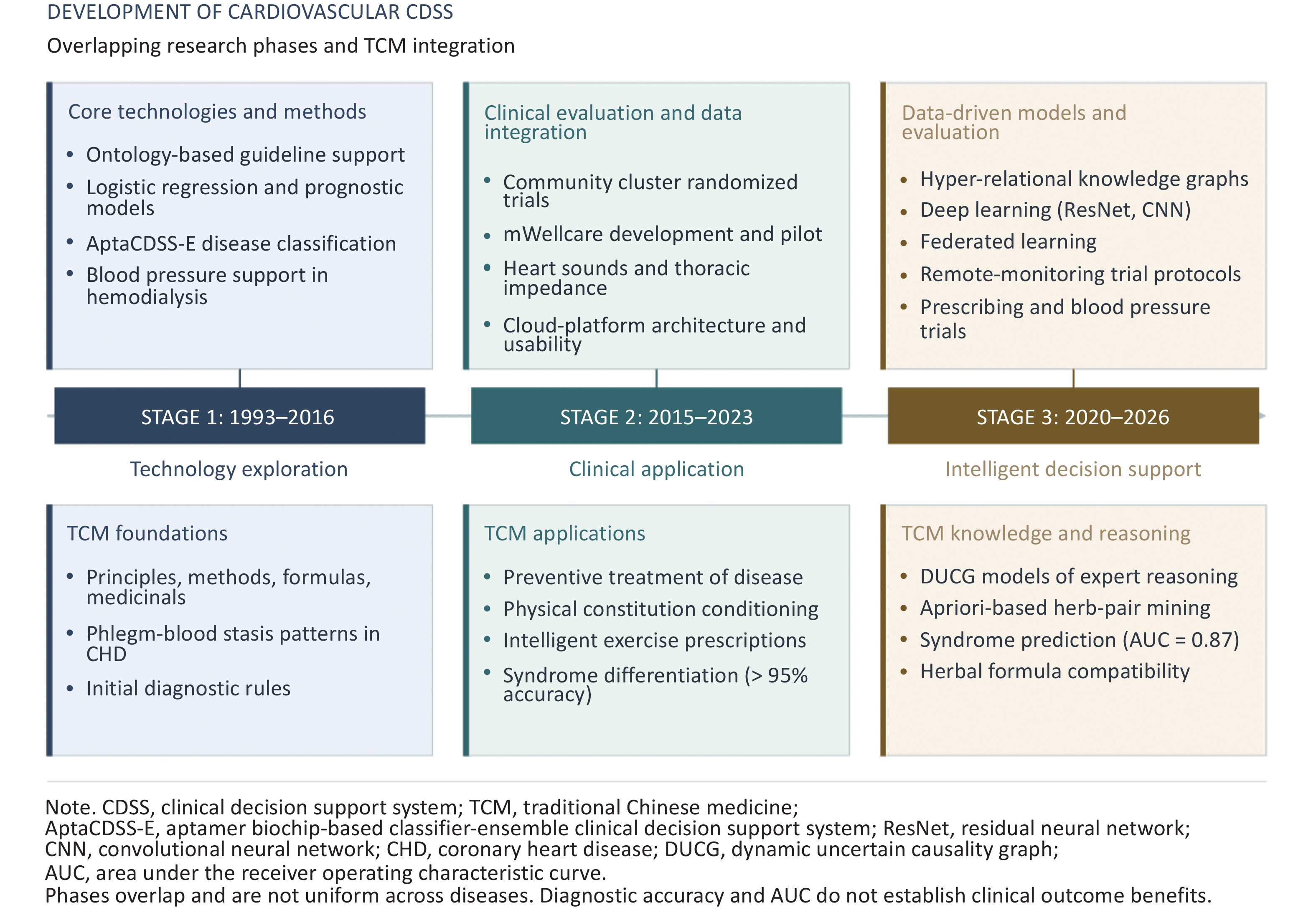
Research on myocardial infarction has progressed from clinical-rule-based prognosis toward data-driven prediction and population-specific risk assessment. Dedicated TCM myocardial infarction CDSS studies were not identified in this review, and the future development of TCM myocardial infarction CDSS should be pursued to provide comprehensive, individualized management plans spanning prevention, treatment, and rehabilitation, with the aim of incorporating TCM approaches to "preventive treatment of disease," acute phase adjuvant treatment, and rehabilitation phase management. The overall evolutionary stages of the CDSS across these cardiovascular domains are summarized in Figure 3 and Table 1.
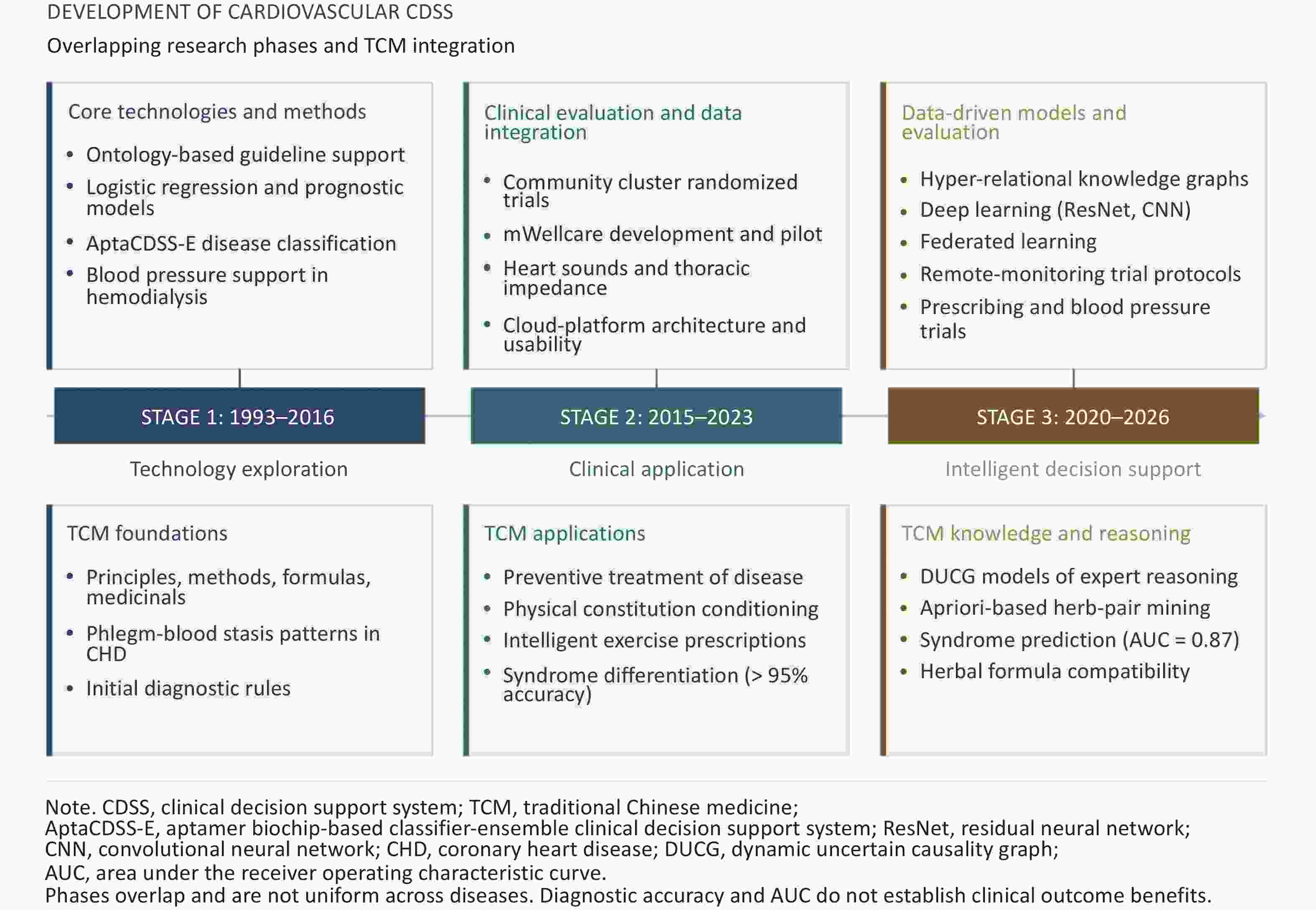
Figure 3. Overlapping developmental phases of cardiovascular CDSS and TCM integration. The phases summarize overlapping research trends rather than uniform stages for every disease. Individual study dates and outcomes are detailed in Table 1. Diagnostic accuracy and AUC do not establish improvements in clinical outcomes. CDSS, clinical decision support system; TCM, traditional Chinese medicine; WHO, World Health Organization; AptaCDSS-E, aptamer biochip-based classifier-ensemble clinical decision support system; ResNet, residual neural network; CNN, convolutional neural network; CHD, coronary heart disease; DUCG, dynamic uncertain causality graph; AUC, area under the receiver operating characteristic curve.
CVD Type Research phase and timeframe Core Technology & Representative Studies TCM Integration & Value Hypertension Stage 1: Knowledge base construction & technology exploration (2007–2014) Ontology-based WHO guideline support; drug–diet interaction support; blood pressure management in hemodialysis [15–17]. Foundational: Laying methodological foundations for subsequent research. Stage 2: Community validation & application promotion (2015–2019) Community cluster randomized trial; mWellcare development and pilot; age-matched comparison in Shenzhen[18–20]. Preventive care: intelligent exercise prescriptions for borderline hypertension, including a 12-week non-randomized study[22]. Stage 3: Knowledge-driven & intelligent decision-making (2020–present) Hyper-relational knowledge graphs; federated learning for gestational hypertension; a primary-care cluster randomized trial reporting prescribing and blood pressure outcomes[7,21,23]. Individualized treatment: TCM expert systems reported > 95% syndrome differentiation and treatment accuracy[14]. These applications span overlapping phases, including the 2019 study. Coronary Heart Disease Diagnostic classification (2008–2016) AptaCDSS-E classifier ensemble (four disease datasets, accuracies > 94%); support vector machine with binary particle swarm optimization[24,25]. No TCM component described in these representative studies. Non-invasive management and risk assessment (2020–2023) Cloud-based platform architecture and usability; OPT-CAD score evaluation in high-bleeding-risk patients with acute coronary syndromes undergoing PCI[26,27]. TCM knowledge graphs and Apriori-based herb-pair mining; syndrome prediction (AUC = 0.87)[12,13]. Heart Failure Multimodal diagnostic research (2018–2023) Heart sounds and thoracic impedance; ECG-based classification; XGBoost comorbidity prediction[28,29]. No TCM component described in these representative diagnostic studies. Remote monitoring and rehabilitation research (2022 onward) A multicenter randomized trial protocol for personalized monitoring and cardiac rehabilitation; no completed efficacy results reported in the protocol[30]. No TCM component described in the cited protocol. TCM expert reasoning (2023) DUCG-based knowledge representation and interpretable reasoning for 10 common chronic HF syndrome types[31]. Expert experience: models of TCM syndrome differentiation and treatment; not evidence of reduced readmission or automatic diuretic adjustment. Arrhythmia Feature-based neural-network classification (2018) Time-scale features from 48 one-minute ECG recordings; Bayesian regularization accuracy 93.8%[32]. No TCM component described in the cited classifier study. Deep-learning classification (2021–2023) Dilated CNNs for atrial fibrillation screening; residual networks for ventricular tachycardia (accuracy 93.2%); multiview residual networks (accuracy 96%)[33–35]. No TCM component described in these representative classifier studies. Interpretable interface development (2024) An interactive CDSS prototype with a dynamic rule flowchart; usability testing was planned[36]. Exploratory integration of ECG, clinical manifestations, and tongue–pulse findings to support TCM syndrome recommendations; clinical benefits require evaluation. Myocardial Infarction (MI) Stage 1: Prognostic models based on simplified clinical rules (1993–2010) Logistic regression models predicting 30-day mortality. N/A. ML prediction (2018–2022) IGS and DNN evaluated separately; integration of ultrasound and medical-record text data[38,39]. N/A. Population-specific risk stratification (2018) Development and validation of an in-hospital mortality risk score for women with acute MI[40]. Future direction: dedicated TCM MI CDSS studies were not identified in this review; prevention, treatment, and rehabilitation remain development priorities. Note. Phases overlap across diseases; the year of each cited study takes precedence over a broad phase label. Accuracy and AUC are model-performance measures, not proof of clinical benefit. CDSS, clinical decision support system; CVD, cardiovascular disease; TCM, traditional Chinese medicine; WHO, World Health Organization; AptaCDSS-E, aptamer biochip-based classifier-ensemble clinical decision support system; OPT-CAD, Optimal antiplatelet Therapy for Chinese patients with Coronary Artery Disease; PCI, percutaneous coronary intervention; AUC, area under the receiver operating characteristic curve; HF, heart failure; ECG, electrocardiogram; XGBoost, extreme gradient boosting; DUCG, dynamic uncertain causality graph; CNN, convolutional neural network; MI, myocardial infarction; ML, machine learning; IGS, integrated genetic algorithm and support vector machine; DNN, deep neural network; N/A, not applicable. Table 1. Evolutionary Stages, Core Technologies, and TCM Integration of CDSS in Cardiovascular Diseases
-
Although both TCM and Western medicine CDSS share the common goal of optimizing clinical decision making, improving medical quality, and enhancing patient prognosis in CVDs, they exhibit significant differences in theoretical foundations, data inputs, decision outputs, and evaluation endpoints because of their distinct underlying medical knowledge and technical pathways[41] (Table 2).
Comparison Dimension Western Medicine CDSS TCM-CDSS Core Medical Theory Relies on evidence-based medical guidelines and pathophysiological indicators of diseases. Follows the system of "principles, methods, formulas, and medicinals" , emphasizing a holistic view and syndrome differentiation and treatment. Focuses on individualized diagnosis and treatment according to person and time, as well as the concept of preventive treatment of disease (prevention first). Core Data Sources Primarily based on quantifiable, multimodal clinical data, medical imaging, genomic data, and biochemical indicators. Deeply relies on the four traditional diagnostic methods of TCM. Concurrently integrates ancient TCM literature and the tacit clinical experience of renowned TCM experts. Decision Output Format Focuses on early disease warning, precise targeted intervention, and guideline-based prescription recommendations. Supports syndrome differentiation, Chinese herbal prescription recommendations, and individualized treatment planning, including shared treatment principles across different diseases. Evaluation Endpoints and Indicators Treatment-process and intermediate outcomes, including prescribing and blood pressure, are reported. Effects on cardiovascular events, rehospitalization, and mortality require direct evaluation. Currently focuses more on evaluating TCM-specific characteristic indicators, such as changes in syndrome scores and the improvement of patient symptoms. Current Challenges Faces issues such as weak synergistic capability for comorbidities and insufficient adaptability at the grassroots clinical level. TCM terminology and expert knowledge remain difficult to standardize; large-scale multicenter RCT evidence for TCM-CDSS is limited. Note. CDSS, clinical decision support system; TCM, traditional Chinese medicine; TCM-CDSS, traditional Chinese medicine clinical decision support system; RCT, randomized controlled trial. This comparison describes typical emphases, not mutually exclusive capabilities. Treatment effects from non-CDSS studies should not be attributed to a CDSS intervention. Table 2. Comparison of Characteristics between Western Medicine CDSS and TCM-CDSS
-
Western Medicine CDSS is deeply rooted in evidence-based medicine and reductionism, and its operation relies heavily on standardized clinical guidelines and clear pathophysiological mechanisms. Its diagnostic logic links clinical findings to disease-focused assessment and intervention, using rule-based or data-driven methods. In contrast, the TCM-CDSS is based on the core theories of holism, syndrome differentiation, and treatment. It considers the human body as an interconnected organic whole, mapping the complex and interdependent clinical manifestations of patients with specific syndromes. Within this comparison, TCM-CDSS places particular emphasis on adjusting the overall constitutional characteristics of patients to achieve early intervention and prevention.
-
The input end of the Western Medicine CDSS primarily relies on quantifiable, multimodal, and objective clinical data, such as genomic data, medical imaging, precise biochemical indicators, and electrocardiogram signals. Conversely, the input end of the TCM-CDSS is highly dependent on four traditional diagnostic methods (inspection, auscultation and olfaction, inquiry, and palpation). This information has strong individualistic, experiential, and subjective characteristics. Furthermore, the TCM-CDSS absorbs a vast amount of ancient TCM literature and the tacit clinical experience of renowned TCM experts, which imposes extremely high requirements on underlying knowledge graphs and natural language processing technologies to establish precise computational models from symptoms to syndromes[42].
-
The output of the Western Medicine CDSS is typically highly standardized and structured, such as single or combined medication recommendations based on guidelines, medication management support, or the ML-estimated risks of adverse clinical outcomes. In contrast, the TCM-CDSS outputs personalized Chinese herbal formula recommendations or non-pharmacological therapies, such as exercise prescriptions and dietary therapy. The output of Chinese herbal formulas requires consideration of the complex "sovereign, minister, assistant, and courier" (Jun-Chen-Zuo-Shi) compatibility rules. Its intervention is characterized by a multi-target and multi-pathway synergistic integration, which offers unique advantages in addressing the complex, multi-factor pathogenic mechanisms of chronic CVDs.
-
Although recent evaluations of advanced ML classifiers have provided useful comparative benchmarks for algorithmic performance in cardiovascular risk modeling[43], purely data-driven ML models often struggle to capture the complex underlying etiologies of chronic conditions. As highlighted by Formanowicz[44], chronic disorders such as CVDs are fundamentally characterized by system-level pathomechanisms and regulatory disturbances. A purely "black-box" algorithmic approach lacks the necessary mechanistic reasoning to address these systemic imbalances. To overcome this problem, the ICWM-CDSS is evolving toward hybrid architectures that combine data-driven analytics with mechanistic medical reasoning.
In this proposed hybrid paradigm, data fusion would link information from Chinese and Western medicine quantitatively. To process the unstructured narratives of the TCM four-diagnostic information, systems could incorporate medical domain-specific large language models (LLMs) to extract standardized features. Furthermore, the core algorithmic reasoning would rely on the integration of TCM knowledge graphs with Western physiological and pathological networks. Instead of superficial correlations, the algorithm would link Western quantitative indicators (such as specific echocardiographic parameters or biomarkers) to TCM macrosyndromes. Such links could support Chinese herbal prescription recommendations informed by CVD pathogenesis, but their validity and clinical utility require evaluation.
-
Evaluation of Western medicine CDSS includes treatment processes and intermediate outcomes, such as blood pressure[7,18]; effects on major adverse cardiovascular events, rehospitalization, and mortality require direct evaluation. The TCM-CDSS focuses more on patient experiences, namely, the improvement of TCM syndrome scores, alleviation of systemic symptoms, and enhancement of overall patient quality of life. However, recent real-world studies and clinical data have indicated that adjunctive TCM treatment combined with standard Western medical treatment is associated with a lower risk of composite cardiovascular events[45,46]. These observational treatment studies did not evaluate a CDSS intervention. These complementary findings provide a rationale for developing ICWM-CDSS, while its effects on patient prognosis require direct evaluation.
-
Current CDSS approaches exhibit significant heterogeneity in study design, dataset scale, and validation methodologies. To evaluate clinical readiness critically, it is essential to stratify these systems based on the robustness of their supporting evidence, distinguishing theoretical algorithms from tools that demonstrate clinical utility.
At the foundational tier, comprising the vast majority of the reviewed literature (n = 159, 79.90%), numerous theoretical and pilot-stage models rely on limited single-center retrospective datasets[13]. Although these systems often report high theoretical diagnostic accuracies or AUC during internal cross-validation, the widespread lack of independent external validation cohorts severely compromises their real-world generalizability. Consequently, the evaluation endpoints are frequently confined to intermediate characteristics, such as improvement in TCM syndrome scores, rather than definitive clinical outcomes[14].
In the intermediate tier, which accounted for approximately 16.08% of the included studies (n = 32), data-driven clinical evaluations of advanced ML models began to report more robust performance metrics. These studies reported measurable model-performance indicators, including diagnostic accuracy[28]; such results should be distinguished from improvements in medication adherence or clinical outcomes. However, critical appraisal reveals that many studies still lack the substantial dataset sizes required to fully capture the epidemiological complexity of CVDs.
Ultimately, the highest echelon of CDSS validation remained remarkably scarce, representing only 4.02% of the analyzed literature (n = 8). This tier includes systems evaluated in prospective clinical studies and randomized controlled trials (RCTs)[7,18]. The cited trials support improvements in prescribing or blood pressure, but do not establish reductions in major adverse cardiovascular events (MACE), rehospitalization, or mortality, or demonstrate regulatory approval. These outcomes require direct evaluation. To increase the scientific value of ICWM-CDSS, future research must systematically transition from retrospective internal validation to rigorous external validation and multicenter RCT designs, explicitly evaluating the impact of these systems on quantified cardiovascular clinical outcomes.
-
To the best of our knowledge, this review contributes an integrated Chinese and Western medicine perspective on cardiovascular CDSS, covering current applications, development trends, and the potential role of TCM-CDSS. The reviewed studies support roles for CDSS in diagnosis, prescribing, and risk assessment, although evidence varies by application. In particular, TCM-CDSS, through individualized diagnosis and treatment models based on syndrome differentiation, offers complementary approaches to symptom management and quality of life that warrant further clinical evaluation.
Despite significant progress in CDSS, their development still faces several challenges. First, there is a serious imbalance in disease coverage. Important disease areas such as valvular heart disease and myocarditis still lack specialized research. Meanwhile, the application of TCM-CDSS is still in its infancy, lacking large-scale, multicenter, randomized, controlled, evidence-based medical research. Several technical bottlenecks also remain. First, multi-disease collaborative capability is weak; clinically common comorbidity scenarios such as hypertension complicated by HF lack integrated solutions, especially integrative Chinese and Western medicine comorbidity management CDSS. Furthermore, the current conceptual framework of the CDSS is largely confined to internal cardiovascular complications, frequently ignoring the co-management of CVDs with other systemic diseases, such as metabolic syndrome or chronic kidney disease. This limitation does not match the actual clinical demand for cross-system and multi-disease management. Second, knowledge-based update mechanisms have a lag. Third, TCM-CDSS development faces unique challenges: non-unified TCM terminology standards, tension between highly personalized syndrome differentiation thinking and computerized standardized expression, and difficulty in formalizing the tacit knowledge of renowned TCM experts. Furthermore, the inherent subjectivity of the four traditional TCM diagnostic methods, coupled with the high complexity of the multi-target and multi-pathway compatibility rules of Chinese herbal formulas, poses significant challenges to the standardization and interpretability of algorithms. Currently, the industry lacks an underlying computational architecture capable of perfectly bridging empirical TCM syndrome differentiation with a precise Western medical diagnosis. Fourth, adaptability in primary care settings is insufficient; many advanced models are difficult to implement at the community level, and the four TCM diagnostic information collection devices are costly, thereby limiting their application. Finally, as discussed in the evidence stratification section, the clinical translation efficacy remains a critical bottleneck. Large-scale, multicenter RCTs tracking hard cardiovascular endpoints are needed to establish clinical benefit. The study protocol for a clinical decision support system and Internet of Things-based comprehensive hypertension management system (CATCH)[47], for example, plans a stepped-wedge cluster randomized trial with blood pressure change as its primary outcome; it does not provide completed efficacy results for TCM-CDSS. Additionally, there is a lack of in-depth interdisciplinary collaboration between medicine and engineering, and TCM-CDSS development requires deeper participation of TCM clinical experts.
-
To address these issues, future CDSS research should focus on breakthroughs in the following directions:
-
Future research should adopt a clear, phased prioritization strategy for clinical validation and the expansion of disease coverage. Initially, priority must be given to conducting large-scale, multicenter clinical validations in domains with well-established data foundations and preliminary algorithmic success, such as CHD and hypertension. Consolidating the high-level of evidence-based efficacy in these mature areas could provide robust methodological templates for the entire field. Subsequently, research efforts and CDSS development should be systematically expanded to address current insufficiently covered fields such as valvular heart disease and myocarditis. Concurrently, integrative TCM knowledge graphs and data-mining models that have shown initial success should be progressively extended to HF, arrhythmia, and other fields in which TCM exhibits unique therapeutic advantages, thereby constructing broader characteristic diagnosis and treatment knowledge systems.
-
To solve comorbidity management challenges, dynamic knowledge graphs capable of supporting cross-disease applications need to be developed, integrating diagnosis and treatment knowledge of multiple diseases to achieve "multi-disease co-management, equal emphasis on Chinese and Western medicine." To address this, future ICWM-CDSS must expand its diagnostic and algorithmic scope beyond that of a single-organ system. By leveraging the holistic view of TCM, which inherently considers systemic interactions across the human body, future models should be designed to simultaneously map and manage the interconnected pathogenic pathways of CVDs and concomitant systemic diseases, thereby offering comprehensive cross-system care. Engines with intelligent guideline updates must also be constructed. At the technology integration level, particular attention should be paid to the deep integration of Chinese and Western medicine knowledge: constructing standardized TCM knowledge bases and unifying TCM terminology; developing intelligent tools for the four TCM diagnostic methods, including objective tongue and pulse data acquisition; establishing renowned TCM expert experience inheritance platforms to transform syndrome differentiation thinking into computable knowledge models. Future systems should actively incorporate medical domain-specific LLMs to overcome the semantic ambiguity inherent in the complex ancient TCM literature and symptom descriptions[48]. By aligning TCM knowledge graphs with Western physiological and pathological networks, these systems can fundamentally bridge the associative mapping between TCM syndrome networks and Western physiological and biochemical indicators at the underlying logical level. These developments could support an integrated decision-making engine for Chinese and Western medicine. Cloud and edge computing could facilitate deployment alongside low-cost, portable devices for the four TCM diagnostic methods.
-
A stepped evidence-generation system, from algorithm development to real-world research, should be implemented. CDSS-specific evaluation frameworks should include multiple dimensions, such as decision efficiency, TCM syndrome scores, and quality of life, particularly incorporating association analysis between TCM characteristic indicators and Western medicine hard endpoints. Future research should adopt the latest real-world study (RWS) design paradigms not only to evaluate the system's immediate control rates of target indicators but also to conduct large-sample, long-term follow-up cohort studies. This approach would test whether integrated Chinese and Western medicine CDSS reduces composite cardiovascular events and delays end-stage disease progression. To strengthen evidence-based foundations, clinical trials specifically designed for ICWM-CDSS should be conducted, with cardiovascular events and mortality rates as hard endpoints and primary outcome indicators, while verifying the clinical efficacy of specific TCM formulas and exploring the influence of different TCM syndrome types on treatment response, thus providing high-level evidence for the individualized application of TCM.
-
To facilitate real-world clinical implementation, resolving the core technical bottlenecks of TCM-CDSSs requires moving beyond algorithmic design to focus on workflow integration. Currently, many systems operate as standalone applications, which disrupts routine clinical practice and contributes to "alert fatigue"[49]. Future ICWM-CDSS must be seamlessly embedded within existing Electronic Health Record systems to align with the actual diagnostic workflows of cardiologists and to support the evaluation of real-world cardiovascular risk management[50].
Furthermore, addressing the feasibility of grassroots applications is paramount in promoting universal access to healthcare. To overcome the bottleneck of high-cost TCM diagnostic equipment in primary care, developers could consider cloud-edge computing architectures. A CDSS capable of self-adapting to different resource environments should be designed, such as deploying lightweight, mobile-based clinical data capture interfaces and stable rule bases in resource-constrained community centers, while utilizing more computationally intensive deep learning models in high-resource areas. A four-month economic evaluation of an AI-assisted prescription review system in 318 primary healthcare institutions in an Anhui county reported reductions in irrational prescriptions and medication expenditure[51]. This provides setting-specific evidence for prescription review; the cost-effectiveness of TCM-CDSS and the proposed cloud-edge deployment still requires direct evaluation.
The establishment of rigorous, regulatory, and ethical quality control systems is critical. Given the multitarget nature of Chinese herbal medicines and the complexities of comorbidity management, algorithms must be constrained by explicit safety safeguards. Before generating a final prescription, the system must perform automated pharmacovigilance and contraindication checks, specifically identifying potentially dangerous herb-drug interactions, such as those between blood-activating TCM herbs and Western antiplatelet agents. Concurrently, bias-elimination mechanisms must be introduced into the algorithm design. The ICWM-CDSS should fully consider the physical and constitutional differences across regions and populations, avoiding stereotyped and uniform herbal prescriptions. By aligning with strict regulatory frameworks and implementing continuous algorithmic auditing, developers can strengthen clinical safety, transparency, and equity in daily care.
-
It is recommended that relevant national departments introduce special policies and formulate technical standards and specifications for TCM-CDSS, which includes the following: TCM knowledge-based construction standards; four diagnostic information collection standards; syndrome differentiation and treatment algorithm standards; evaluation and certification systems for TCM-CDSSs to ensure safety, effectiveness, and clinical applicability; and strengthening the cultivation of interdisciplinary professionals who understand both TCM and information technology.
-
Several limitations should be considered when interpreting this review of cardiovascular CDSS from an integrative Chinese and Western medicine perspective. Primarily, there is a distinct limitation regarding literature sources. Because research on TCM-CDSSs is predominantly conducted in China, a significantly high proportion of the TCM-related literature cited in this review is published in Chinese, with a relative scarcity of English-language publications. This language bias may diminish the international visibility of TCM-CDSS research and impede its comprehensive integration into the global academic discourse. Researchers in the TCM-CDSS field should be strongly encouraged to publish technological breakthroughs in international peer-reviewed journals and improve the quality of their English abstracts to foster broader scientific communication.
-
In conclusion, CDSS have tremendous potential for application in CVD management. Particularly, the development of TCM-CDSS provides unique value of "syndrome differentiation and treatment, individualized diagnosis and treatment" and "preventive treatment of disease, prevention first" for CVD prevention and treatment, showing broad application prospects in the prevention and treatment of hypertension, CHD, and other diseases. However, current systems still face challenges in data quality and precision of personalized prediction; TCM-CDSS development also faces issues such as insufficient knowledge base standardization and lack of evidence-based medical evidence. Looking to the future, with the continuous evolution of AI technology and the deepening advancement of TCM informatization, the paradigm shift from a 'dual-track parallel' state to 'integrated innovation' will become the crucial trajectory for CDSS development. By fusing the underlying knowledge systems and algorithmic models of both medical traditions, this integrative approach could support more comprehensive, precise, and individualized diagnosis and treatment plans for patients with CVDs. Researchers must commit to improving system accuracy, reliability, and safety, fully promoting the deep integration of cutting-edge technology and clinical practice, and strengthening the combination of TCM theory and modern information technology. Only through this approach can CVD management advance toward a new era characterized by greater precision, efficiency, and universal benefits.
-
In accordance with the current journal transparency policies, the authors declare that AI tools were utilized during the preparation of this manuscript. Specifically, AI-assisted technologies were used for language translation, stylistic refinement, structural optimization, reference retrieval and consistency checking, and editing figure labels. The human authors are responsible for critically reviewing and approving all AI-assisted text, reference checks, and figures before submission. The authors assume full responsibility for the content, scientific accuracy, and integrity of the final manuscript.
HTML
Search Strategy and Data Sources
Inclusion and Exclusion Criteria
Study Selection and Data Extraction Process
Hypertension and CDSS
CHD and CDSS
Heart Failure and CDSS
Arrhythmia and CDSS
Myocardial Infarction and CDSS
Theoretical Foundations and Diagnostic Logic
Data Inputs and Feature Engineering
Decision Outputs and Interventions
Hybrid Architectures and Mechanism-data Dual-driven Fusion
Evaluation Endpoints and Efficacy Assessment
Performance Metrics and Clinical Evidence Stratification
Establish a Phased Research Priority and Gradually Expand Disease Coverage
Deepen Technology Integration, Improve System Synergy and Accessibility
Optimize Clinical Translation Pathways and Strengthen Evidence-based Foundations
Overcoming Technical Bottlenecks: Workflow Integration, Quality Control, and Ethical Equity
Strengthen Policy Support and Standardization Construction, Promote Standardized Development of TCM-CDSS
Declaration of Generative AI and AI-assisted Technologies in the Writing Process
Competing Interests None.
Authors’ Contributions Conception and study design: Zihan Jia, Lei Zhang, and Lin Tong. Data acquisition, analysis, and interpretation: Zihan Jia, Lei Zhang, Lin Tong, Huifang Zhang, Hongtao Li, Fengxia Zhang, Siwei Tian, Zhuang Guo, Siqi Zhang, Yan Ma, and Huamin Zhang. Manuscript approval and responsibility for accuracy and integrity: all authors.
&These authors contributed equally to this work.

 Quick Links
 DownLoad: