




-
Occupational noise-induced hearing loss (NIHL) remains one of the most common and preventable work-related disorders. Occupational and environmental noise also contribute to broader health burdens, although the present Perspective focuses on hearing-based occupational exposure limits[1–3]. However, many regulatory systems still communicate a simplified binary message: exposure below a single 8 h limit is acceptable, whereas exposure above it requires control. That message is useful for administration, but it is biologically incomplete. It conflates three determinants of risk that should be considered separately: the acoustic energy of exposure, the temporal structure of the waveform, and the programmatic or behavioral factors that determine the actual at-ear dose. A modern occupational noise framework should therefore retain the strengths of equivalent-level metrics while correcting their most important weakness: the assumption that all exposures with the same energy are equally hazardous.
Current regulatory and standard-setting frameworks in the United States, the European Union, China, and international standard-setting bodies remain anchored mainly in equivalent-level metrics, time normalization, and related measurement strategies[4-11] These frameworks have improved surveillance and enforcement but do not adequately distinguish steady Gaussian exposure from highly impulsive or non-Gaussian exposure with the same A-weighted equivalent continuous sound pressure level normalized to an 8 h working day (LAeq,8h) or noise exposure level normalized to an 8 h working day (LEX,8h).
In this Perspective, complex industrial noise refers to occupational noise with a time waveform departs substantially from steady-state Gaussian noise. It may contain impulses, impacts, intermittent bursts, high crest factors, rapid fluctuations, or non-Gaussian amplitude distributions. Such conditions are common in metal fabrication, stamping, forging, textile manufacturing, mechanical processing, construction, shipbuilding, and other settings, where continuous machinery noise is mixed with transient high-level events. More importantly, complex noise is not defined only by the peak sound pressure level. Since the 1980s, impulsiveness has been recognized as a distributional property of the waveform rather than merely a peak-level issue[12]. A workplace may have a moderate LAeq,8h or LEX,8h but still have a waveform with high peakedness and a greater cochlear hazard than expected from energy alone[13–20].
The equal-energy hypothesis has served occupational hygiene well because it offers a simple and reproducible way to integrate sound level and duration. However, the hypothesis becomes less secure when the exposure contains pronounced impulsiveness or temporal irregularity. Accumulating experimental evidence has shown that non-Gaussian or complex noise can produce greater permanent threshold shift than Gaussian or steady noise at the same equivalent sound level[13,14]. Epidemiological studies among industrial workers have reached the same general conclusion: an energy metric alone does not fully explain NIHL risk when noise temporal structure differs[15–18,20]. The practical implication is not to abandon LAeq,8h or LEX,8h, but to extend them with a validated temporal-structure modifier.
Current occupational noise frameworks illustrate both convergence and limitation. In the United States, the Occupational Safety and Health Administration (OSHA) permissible exposure limit is 90 dB(A) as an 8 h time-weighted average using a 5 dB exchange rate, with an 85 dB(A) action level for hearing conservation[4]. The National Institute for Occupational Safety and Health (NIOSH) recommends a more protective 85 dB(A), 8 h recommended exposure limit using a 3 dB exchange rate and recognizes residual excess risk even at that level[5]. In the European Union, Directive 2003/10/EC specifies lower and upper exposure action values of 80 and 85 dB(A) LEX,8h, and an exposure limit value of 87 dB(A), together with C-weighted peak criteria[6]. In China, GBZ 2.2-2007 sets 85 dB(A) for steady and non-steady noise and normalizes non-standard schedules to LEX,8h or noise exposure level normalized to a 40 h working week (LEX,W) according to GBZ/T 189.8-2007[7,8]. GBZ 2.2-2007 also specifies impulse-number-based peak criteria for impulsive noise[7]. These systems differ in exchange rate, management trigger, and peak-level treatment, but all remain anchored mainly in energy.
Framework Core energy limit Management trigger(s) Exchange-rate convention Peak or impulsive-noise criterion U.S. OSHA PEL: 90 dB(A), 8 h TWA Action level: 85 dB(A) 5 dB Exposure to impulsive or impact noise should not exceed 140 dB peak sound pressure level. U.S. NIOSH REL: 85 dB(A), 8 h TWA Hearing-loss prevention at or above the REL 3 dB Energy-based REL; impulse/impact risk addressed through prevention guidance and peak-level considerations. European Union Exposure limit value: 87 dB(A) LEX,8h Lower and upper action values: 80 and 85 dB(A) Equal-energy orientation C-weighted peak criteria: 135, 137, and 140 dB(C) for lower action, upper action, and exposure limit values, respectively. China GBZ 2.2-2007 OEL: 85 dB(A) for steady and non-steady noise No formal staged action level in GBZ 2.2-2007; graded management commonly begins at 80 dB(A) under GBZ/T 229.4-2012 Equivalent-level normalization to LEX,8h and LEX,W Impulsive noise peak criteria by daily impulse number: n ≤ 100, 140 dB(A); 100 < n ≤ 1,000, 130 dB(A); 1,000 < n ≤ 10,000, 120 dB(A). Note. OSHA,Occupational Safety and Health Administration; NIOSH, National Institute for Occupational Safety and Health; OEL, occupational exposure limit; PEL, permissible exposure limit; REL, recommended exposure limit; TWA, time-weighted average; LEX,8h, noise exposure level normalized to an 8 h working day; LEX,W, noise exposure level normalized to a 40 h working week. The Chinese impulse criteria are peak-based and event-count-based; they do not replace a waveform-distribution metric such as kurtosis. Data are summarized from relevant regulatory and standard-setting sources[4–9]. Table 1. Selected occupational noise frameworks and their treatment of energy and peak/impulsive exposure
The limitation of energy-only regulation becomes clearer if occupational risk is expressed as a three-component construct: biologically effective dose = energy dose + temporal-structure modifier + effective at-ear exposure behavior. Energy dose is captured by LAeq,8h, LEX,8h, time-weighted average (TWA), or cumulative noise exposure. Temporal structure can be quantified from the waveform; kurtosis is currently the most mature candidate because it describes the peakedness of the amplitude distribution[12–20]. Effective at-ear exposure behaviors include hearing-protector fit, consistency of use, training, supervision, and the tendency of workers and programs to respond differently around regulatory thresholds. This model explains why a simple monotonic relationship between ambient LAeq and hearing loss may fail in real workplaces even when noise remains the causal hazard.
Kurtosis is defined as β = E[(x - μ)4]/σ4, where x is the instantaneous sound-pressure waveform, μ is the mean, and σ is the standard deviation. A Gaussian waveform has β approximately equal to 3. High-kurtosis noise contains more extreme amplitude excursions and a more peaked temporal structure. Accumulating animal and human evidence has supported the use of kurtosis as an adjunct to energy in evaluating complex noise hazards[13–20]. These studies have shown that adding kurtosis to energy metrics improves dose-response coherence and reduces the systematic underestimation of hearing risk in high-kurtosis industrial noise.
The influential aluminum-worker cohort analyzed by Rabinowitz et al. provides an important behavioral and programmatic lesson. In that 10 year analysis of 6,217 employees of an aluminum manufacturing company, industrial hygiene and human-resources records were used to reconstruct individual ambient noise exposure[21]. Contrary to a simple energy-only expectation, workers in higher ambient-noise jobs tended to show less high-frequency hearing loss than workers in lower ambient-noise categories, and the majority of the 10-dB standard threshold shifts occurred among workers whose calculated ambient exposures were at or below 85 dB(A)[21]. These results do not imply that higher noise is harmless. Rather, they show that ambient energy categories can be distorted by differential use of hearing protectors, program behavior, exposure misclassification, and threshold-driven prevention efforts. Subsequent work showed that daily monitoring inside hearing protectors could reduce annual rates of hearing loss, further emphasizing that actual at-ear dose and behavior must be part of the conceptual framework[22].
The most directly relevant evidence for OEL revision comes from recent Chinese full-shift waveform studies of industrial workers exposed to complex noise. Liu et al. analyzed 3,421 male workers and evaluated excess NIHL risk in relation to equivalent level and kurtosis[23]. Full-shift personal noise recordings were collected at 48 kHz with 32 bit resolution. Kurtosis was calculated in consecutive 60 s windows and summarized by geometric averaging, an approach supported by prior methodological work showing that window duration affects the accuracy of NIHL prediction[24]. Hearing impairment was evaluated using two endpoints: PTA1234-AI, a 1-4 kHz articulation-index-weighted measure emphasizing speech-relevant frequencies, and PTA346, a 3-6 kHz measure more sensitive to early high-frequency NIHL[23].
The study showed a clear exposure-risk pattern, but not one adequately described by energy alone. Complex-noise exposure produced a higher excess risk than expected under steady-state assumptions, and excess risk increased as kurtosis increased[23]. The two hearing endpoints also behaved differently. PTA346 was more sensitive to early high-frequency damage, whereas PTA1234-AI became more informative with longer cumulative exposure and greater speech-frequency involvement. Derivative analysis of the excess-risk curves suggested that, for complex-noise environments, the conventional 85 dB(A) boundary may need to be lowered to approximately 80 dB(A) when the protective endpoint is PTA1234-AI and to approximately 77 dB(A) when the endpoint is PTA346. Under high-kurtosis conditions, an additional reduction of about 2 dB was supported, with provisional high-kurtosis triggers of β ≥ 70 for PTA1234-AI and β ≥ 25 for PTA346[23].
Protective endpoint Candidate baseline reference level High-kurtosis trigger Candidate adjusted reference level Policy interpretation PTA1234-AI, speech-relevant impairment 80 dB(A) β ≥ 70 78 dB(A) Health-protective reference point for reducing longer-term speech-relevant impairment in complex noise. PTA346, early high-frequency NIHL 77 dB(A) β ≥ 25 75 dB(A) More precautionary reference point for early high-frequency vulnerability in moderate- to high-kurtosis environments. Note. Candidate values are derived from excess-risk and derivative analyses in the recent Chinese industrial cohort and should be interpreted as health-protective reference points rather than immediately universal mandatory limits[23]. OEL, occupational exposure limit; NIHL, noise-induced hearing loss. Table 2. Evidence-based candidate OEL reference points for complex-noise environments
These values should be interpreted as candidate health-protective reference points derived from current epidemiological evidence, not as immediately universal mandatory limits[23]. A staged implementation strategy could first use them for surveillance, risk communication, control prioritization, and validation in additional cohorts before formal regulatory adoption.
The feasibility concern is important. Full-shift personal waveform monitoring is the preferred approach for research, validation, high-risk jobs, and highly variable exposures, but it should not be the only acceptable pathway for national practice. A tiered measurement strategy is more realistic. Level 1 would use full-shift personal waveform monitoring when complex noise is suspected or when the results will inform standard setting. Level 2 would use representative-period or task-based waveform monitoring when jobs have stable task structures, repeated production cycles, or identifiable high-impulsiveness tasks. Level 3 would use conventional LAeq,8h or LEX,8h screening, plus targeted waveform sampling to determine whether high-kurtosis conditions are present. This structure is compatible with the measurement-strategy logic of ISO 9612:2025, which specifies task-based, job-based, and full-day strategies for occupational noise exposure assessment[11].
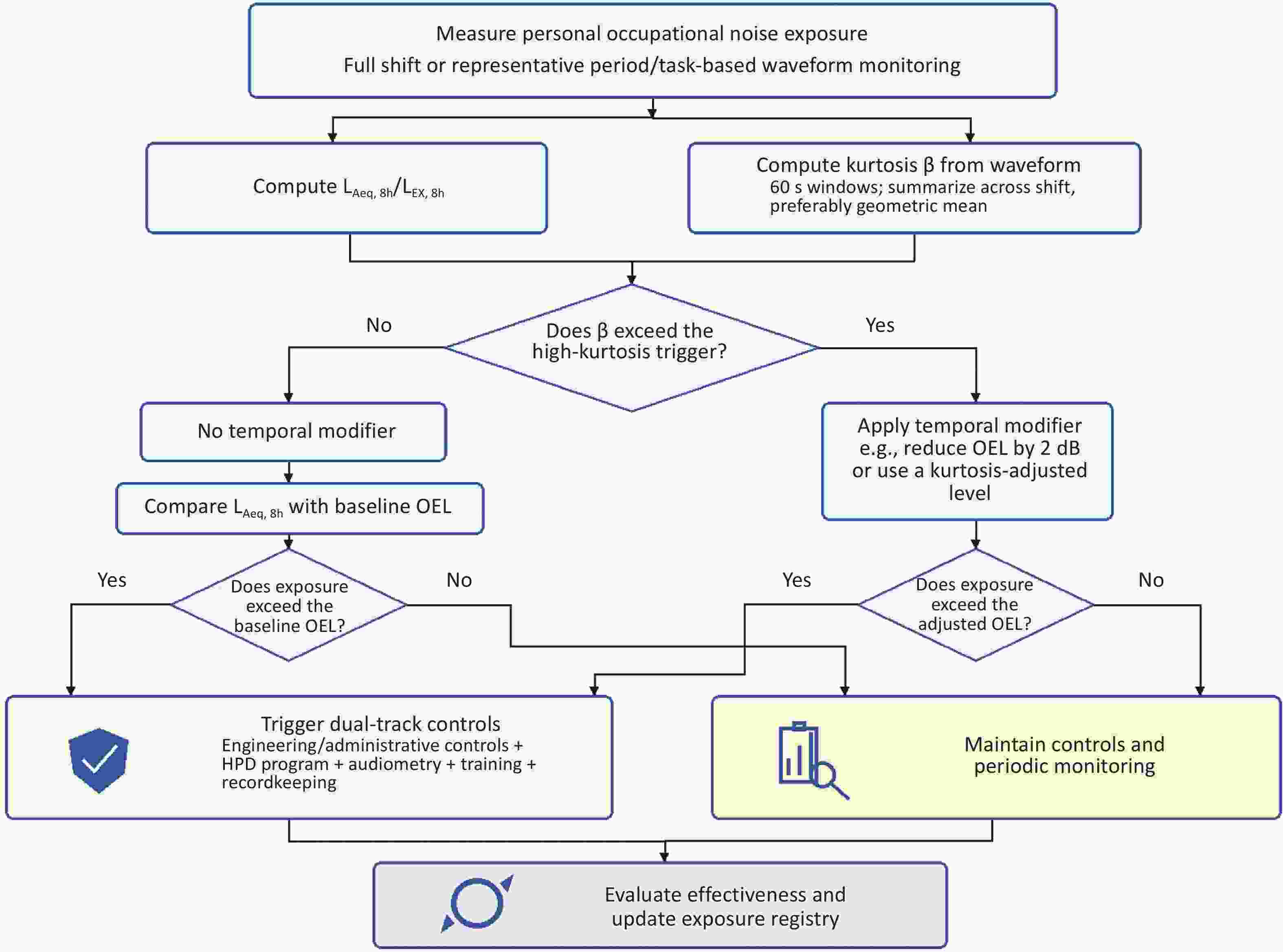
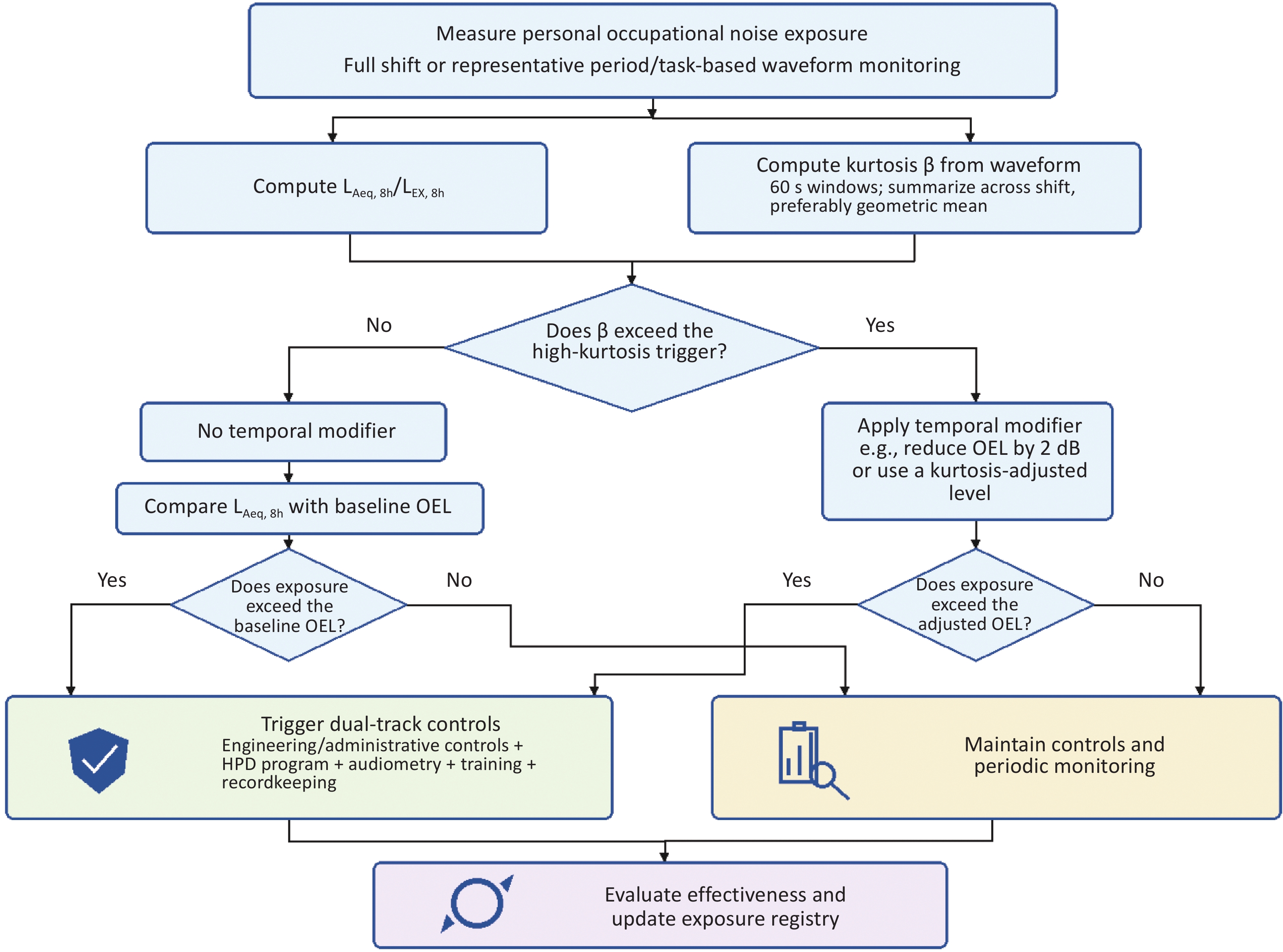
Figure 1. Procedural pathway for a dual-axis occupational noise framework integrating energy and temporal structure.OEL, occupational exposure limit; HPD, hearing protection device; LEX,8h, noise exposure level normalized to an 8 h working day; LAeq,8h, A-weighted equivalent continuous sound pressure level normalized to an 8 h working day.
This pathway is deliberately compatibility-preserving. It does not ask regulators or enterprises to discard the metrics already embedded in surveillance and compliance systems. Instead, it asks them to recognize a second axis of hazard. The energy axis determines whether the exposure is excessive by conventional criteria. The temporal-structure axis determines whether the same energy should be treated as more hazardous because it is delivered in a more damaging waveform. In practice, a moderate LAeq,8h with high kurtosis should no longer be communicated as simply “below the limit.” It should trigger closer exposure evaluation, engineering or administrative controls, hearing protection device (HPD) fit testing, worker training, and audiometric follow-up.
The proposed framework also clarifies the long-standing debate over 3 dB versus 5 dB exchange rates. A 3 dB exchange rate is more consistent with acoustic energy conservation and is more protective than a 5 dB exchange rate[5,25,26]. However, the exchange rate alone addresses only the tradeoff between level and duration within an energy model. It does not account for waveform peakedness, intermittency, impulse clustering, or the distribution of sound-pressure amplitudes. Therefore, adopting a 3 dB exchange rate is necessary but not sufficient for complex noise. Temporal structure must be assessed explicitly.
Several implementation safeguards are needed before kurtosis-adjusted limits become mandatory standards. First, field protocols must define signal duration, sampling rate, frequency weighting, calibration, window length, overlap, artifact rejection, and aggregation method. Second, the 60 s window and geometric mean should be treated as a technically reasonable starting point, not as a closed methodological question[24]. Third, future validation should compare arithmetic and geometric averaging, A-weighted and C-weighted or unweighted waveforms, and task-level versus shift-level β. Fourth, hearing-protector fit and at-ear exposure should be recorded where possible, because a high ambient dose may not be the same as a high cochlear dose when protection is effective, and a moderate ambient dose may remain hazardous when protection is absent or inconsistently used[21,22].
The public-health message should also change. The statement “85 dB(A) is safe” is scientifically misleading. A more accurate message is that risk increases with energy, duration, temporal structure, and actual at-ear dose. The conventional 85 dB(A) boundary should be treated as an administrative and preventive trigger, not as a biological cliff. This distinction is especially important in complex-noise workplaces, where moderate equivalent levels may coexist with high kurtosis and early high-frequency damage[15–20,23].
Future revisions of occupational noise policy should also consider health outcomes beyond hearing. Occupational and environmental noise have been associated with cardiovascular, sleep, stress-related, cognitive, and other non-auditory outcomes[3]. This Perspective focuses on hearing-based OELs because the evidence for kurtosis adjustment is currently strongest for NIHL, permanent threshold shift, and audiometric endpoints. Further studies are needed to determine whether temporal-structure metrics, including kurtosis, also improve the prediction of non-auditory effects. A comprehensive occupational noise policy should ultimately address both auditory and non-auditory health, while recognizing that exposure metrics and biological mechanisms may differ across outcomes.
In summary, the era of complex industrial noise requires a more informative exposure framework. Equivalent-level metrics remain indispensable, but they should not be the sole basis for judging risk when waveform temporal structure is severe. The accumulated animal, human, and full-shift waveform evidence supports a direct next step: retain LAeq,8h or LEX,8h as the energy anchor; add standardized kurtosis measurement as a temporal-structure axis; use candidate health-protective values such as 80 dB(A), 77 dB(A), and approximately 2 dB high-kurtosis modifiers as reference points for staged validation; and incorporate hearing-protector behavior and at-ear dose reconstruction into surveillance. This approach would align occupational noise policy more closely with contemporary auditory science while preserving continuity with existing industrial hygiene practice[13–20,23].
HTML
Competing Interests The author declares no competing interests.
Ethics Not applicable. This Perspective did not involve human participants, identifiable personal data, or animal experiments.
Authors' Contributions Conceptualization, literature interpretation, manuscript drafting, and critical revision: Wei Qiu.
Data Sharing No new data were generated or analyzed for this Perspective. Data sharing is not applicable.
Reference

 Quick Links

 DownLoad: